





Home > Latest News > Blended Family Estate Planning in 2026 and How to Protect Your Loved Ones
Blended Family Estate Planning in 2026 and How to Protect Your Loved Ones
Date added: 16/06/26
Did you know that over 40% of adults now have at least one step-relationship within their family circle? While modern families come in many beautiful forms, the reality of blended family estate planning often brings a unique set of worries that traditional wills simply cannot resolve.
You might feel a lingering anxiety that your children could be unintentionally disinherited by a step-parent, or perhaps you fear that your passing might spark painful disputes between the people you love most. It is a heavy burden to carry, but it is one that many compassionate parents and partners share.
We believe that your hard-earned legacy deserves to be a source of harmony rather than conflict. You can balance the needs of your spouse and children whilst ensuring your history is preserved exactly as you intended.
This guide provides a clear path towards legal certainty, moving past complex jargon to offer genuine peace of mind. With the professional oversight of an Estate planning consultant, we will explore how the 2026 tax landscape and specific tools like a Protective Will Trust can shield your assets from future litigation and ensure your loved ones are looked after for years to come.
Key Takeaways
- Bridge the Gap Understand why standard inheritance laws often fail to protect stepchildren and how specific blended family estate planning strategies resolve this.
- The Mirror Will Trap Discover the risks associated with basic mirror wills and how they might unintentionally leave your biological children without an inheritance.
- Ring-Fence Assets Learn how to use protective trusts to provide for your surviving partner whilst securing assets for your own children.
- Prevent Litigation Explore the importance of transparency and how a letter of wishes can help prevent future family disputes.
- Expert Navigation See how an Estate planning consultant can simplify complex legal jargon and create a secure plan tailored to your unique family structure.
Table of Contents
- 1. The Complexities of Estate Planning for Modern Blended Families
- 2. Why Basic Mirror Wills Might Not Protect Your Children
- 3. Using Trusts to Balance Competing Family Needs
- 4. Practical Considerations for a Harmonious Legacy
- 5. How an Estate Planning Consultant Secures Your Peace of Mind
Need expert advice?
If you would like to discuss your family’s unique circumstances with a professional, please get in touch with our team today.
1. The Complexities of Estate Planning for Modern Blended Families
Modern life is wonderfully varied. Today, the traditional nuclear family is just one of many ways we choose to live and love. Statistics indicate that around 15% of children now grow up in blended households, while over 40% of adults have at least one step-relationship. This evolution reflects a society that values second chances and expanded support networks.
These beautiful complexities mean that blended family estate planning requires a more nuanced approach than a standard document might provide. It is a protective measure that ensures your history is preserved for every branch of your family tree.
A common concern for many parents is how to remain fair to everyone. You want to ensure your current partner is comfortable and secure, yet you also feel a deep responsibility to protect your biological children's inheritance. Without a structured plan, these competing needs can lead to unintended friction.
Professional guidance acts as a vital bridge, transforming potential conflict into a shared sense of security. Engaging in estate planning mediation or simply having open conversations can help align these different interests. An Estate planning consultant can help you navigate these sensitive waters with a calm and expert hand.
Understanding the Challenges of Stepfamilies and Multiple Interests
When you enter a second marriage or a long-term partnership, the number of stakeholders in your legacy naturally increases. You are balancing the welfare of your spouse, your children from a previous relationship, and perhaps even stepchildren who have become like your own.
Each group has its own valid expectations. If these priorities aren't clearly defined, it can create a vacuum where assumptions lead to resentment. Recognising every family member in your plan isn't just about the financial value; it's about acknowledging their place in your life. This proactive approach prevents the anxiety of being left out and fosters long-term family harmony.
The Risks of Relying on Intestacy Rules
Many people believe that the law will naturally do the right thing if they pass away without a Will. This is a risky assumption. Intestacy rules are rigid and often fail to account for the nuances of modern step-relationships.
Spousal Prioritisation
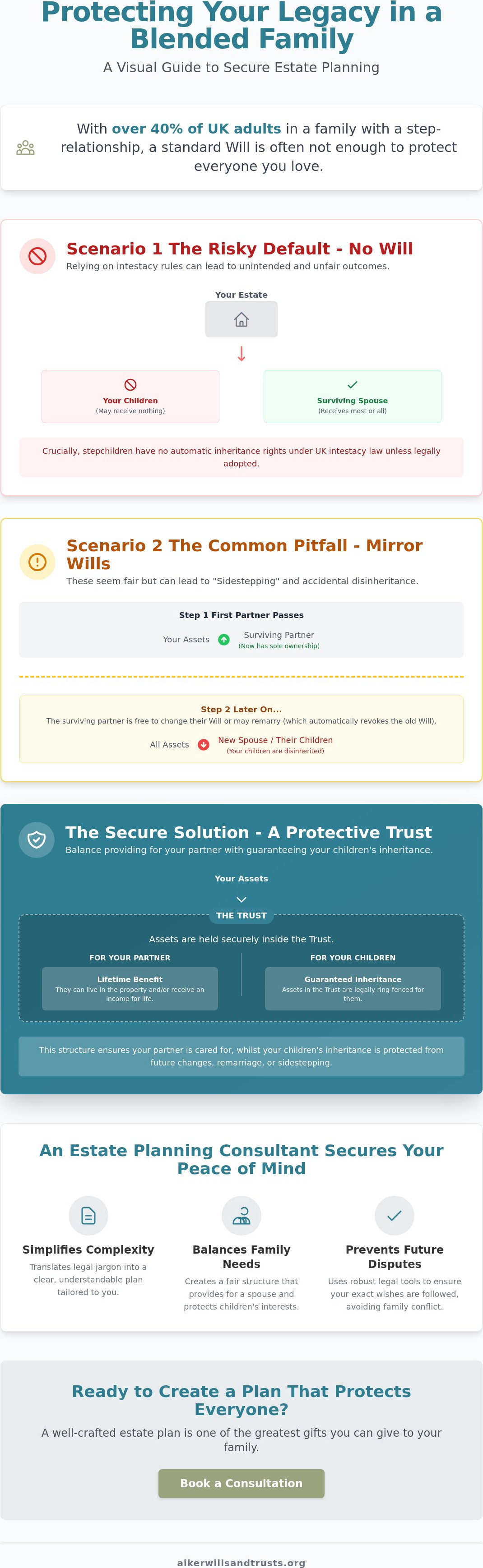
In many cases, these rules prioritise the surviving spouse to such an extent that children from a previous marriage may receive nothing.
Stepchildren Exclusion
Crucially, stepchildren have no automatic right to inherit under UK intestacy laws unless they have been legally adopted.
This can lead to significant financial hardship and a sense of exclusion. Securing a professional Will is the only way to ensure your intentions are legally binding and your loved ones are protected.
2. Why Basic Mirror Wills Might Not Protect Your Children
Mirror Wills are a popular choice for many couples because they offer a simple, reciprocal arrangement. Essentially, you leave everything to your partner, and they do the same for you.
While this may feel like a natural expression of trust, it can create significant vulnerabilities in blended family estate planning. Once the first partner passes away, the survivor becomes the sole owner of all joint assets. This means they have the absolute legal right to do whatever they wish with that inheritance, including changing their Will entirely at a later date.
There is also the risk of unintentional revocation. Under current law, if a surviving spouse remarries, any Will they previously made is usually automatically cancelled. Without a new document in place, your hard-earned assets could pass to a new spouse under intestacy rules, effectively disinheriting your own children. Following practical estate planning tips for blended families is essential to avoid these common traps. You want to ensure that your love for your partner doesn't inadvertently compromise your children's future security.
The Problem of Sidestepping and Accidental Disinheritance
Sidestepping occurs when assets meant for your biological children are diverted elsewhere. This isn't always intentional.
Long-Term Care Costs
If a surviving partner needs long-term care later in life, the assets they inherited from you could be completely depleted to pay for those fees.
New Relationships
If they enter a new relationship, those funds might be shared with a new partner or a new set of stepchildren.
Relying on a verbal promise that your children will be looked after isn't a secure legal strategy. It places an unfair emotional burden on the survivor and offers no protection if circumstances change. Using a Protective Will Property Trust can provide a much more reliable solution.
Managing Potential Claims from Former Spouses
It's vital to consider how past relationships might impact your current estate. If you have a former spouse, they may still have a claim against your assets depending on the terms of your divorce settlement.
Reviewing old documents is a critical step in the planning process. You must ensure that your current partner and children are not left vulnerable to external claims that could have been resolved through professional oversight. If you're feeling unsure about your current arrangements, speaking with an Estate planning consultant can provide the clarity you need.
3. Using Trusts to Balance Competing Family Needs
While a standard Will often feels like a final statement, a trust is a living, protective structure that safeguards your family. In the context of blended family estate planning, trusts are considered the gold standard. They provide something a simple Will cannot, which is the ability to separate the immediate use of an asset from its eventual ownership.
This legal distinction allows you to be generous to your surviving partner whilst remaining fiercely protective of your children’s long-term interests. It replaces the uncertainty of a verbal promise with the absolute clarity of a legal framework.
The 2026 Tax Angle, Frozen Thresholds
Navigating trusts carefully is more critical than ever under the 2026 tax landscape. With the UK's standard Nil-Rate Band (£325,000) and Residence Nil-Rate Band (£175,000) officially frozen, simply dumping all assets onto a surviving spouse outright can accidentally expand their personal estate, pushing them far over the inheritance tax (IHT) thresholds down the line. A structured trust allows for smart asset management without creating an unnecessary future tax bill for your loved ones.
| Trust Type | Primary Purpose for Blended Families | Key Benefit |
|---|---|---|
| Protective Will Property Trust | Protects the family home. | Allows a spouse to live in the home for life, but guarantees the property's capital passes to your biological children. |
| Immediate Post-Death Interest Trust (IPDI) | Manages a broader range of assets (cash, investments, shares). | Provides the surviving spouse with a lifelong income stream, while ring-fencing the underlying wealth for your children. |
Professional oversight from an Estate planning consultant ensures these arrangements are robust, legally compliant, and reflect your exact intentions, providing total peace of mind for everyone involved.
4. Practical Considerations for a Harmonious Legacy
A well-drafted legal document is the foundation of security, but the human element is what truly preserves a family’s bond. Silence often creates a vacuum where assumptions and anxieties grow. By embracing transparency early in the process, you can replace potential suspicion with understanding. Managing expectations now is the most effective way to prevent future challenges to your Will.
Choosing the Right Executors and Trustees
The role of an executor is demanding, involving significant legal and financial responsibilities. In a blended family, appointing a family member as the sole executor can sometimes lead to accusations of bias, even if their actions are perfectly fair.
This is where a professional executor service provides essential balance. A professional acts with complete objectivity, ensuring the estate is administered strictly in accordance with your wishes. When choosing trustees for long-term structures, look for individuals or professionals who possess the diligence to manage assets over many years and the emotional intelligence to navigate family dynamics with grace.
Open Communication and the Letter of Wishes
Your Will is a formal legal instruction, but a Letter of Wishes is your personal voice. It allows you to explain the logic behind your decisions in a way that a legal document cannot. While it is not legally binding, it provides vital guidance to your executors and trustees.
Best practice is to store this letter alongside your Will and review it regularly. As your family evolves, your supplementary documents should reflect those changes.
5. How an Estate Planning Consultant Secures Your Peace of Mind
Planning for the future is a deeply personal journey that goes far beyond simple paperwork. It is about the people you love and the history you have built together. An Estate planning consultant acts as a dedicated guardian for your achievements, helping to translate complex legal jargon into clear, actionable strategies.
Because our firm works in close, respectful collaboration with SRA-regulated solicitors, including our partners at Aiker Legal Ltd, we ensure that every element of your plan is backed by the highest professional standards and absolute legal certainty. Effective blended family estate planning is built on this foundation of professional oversight and human empathy.
Personalised Guidance
We believe that sensitive life-planning deserves a personal touch. For our clients in Wrexham, across North Wales, and throughout the UK, we offer local expertise and the convenience of home visits. Discussing your family’s unique needs in the comfort of your own home allows for a more relaxed and open conversation. This face-to-face consultation with a dedicated expert ensures that no detail is overlooked.
The Importance of Regular Reviews as Families Evolve
A secure estate plan should never be a static document. It is a living reflection of your life that should grow and evolve as your family does. We encourage our clients to view their plan as a long-term collaboration.
There are several key triggers that should prompt a review of your arrangements
- The birth of a child or grandchild within the family.
- A new marriage or civil partnership (which can completely invalidate existing Wills).
- Significant changes in your financial assets, property ownership, or shifting tax laws.
- Changes in the health or circumstances of your chosen executors or trustees.
Our commitment to a lifelong advisory relationship means we are always here to ensure your wishes remain valid, compliant, and relevant in today's changing legal environment.
Frequently Asked Questions
Do stepchildren have automatic inheritance rights in the UK?
Stepchildren do not have any automatic legal right to inherit from a step-parent under the current rules of intestacy unless they have been legally adopted. Even if you have lived together for many years, the law treats them as legal strangers to your estate. To ensure they are provided for, you must explicitly name them in your Will or include them as beneficiaries within a trust structure.
What happens if I die without a will in a blended family?
If you die without a valid Will, your assets are distributed according to the rigid rules of intestacy. Usually, the surviving spouse receives the first portion of the estate and all personal belongings, whilst the remainder is shared among biological or adopted children. This leaves stepchildren and unmarried partners with nothing, which can cause significant financial distress and avoidable family conflict during a time of grief.
Can a new marriage invalidate my existing will?
Yes. A new marriage or civil partnership in England and Wales will usually revoke any existing Will automatically unless that document was specifically made in "contemplation of the marriage." This is a significant risk in blended-family estate planning, as it can inadvertently disinherit children from a previous relationship.
How can I ensure my spouse is provided for while protecting my children?
You can achieve this balance by using a protective trust within your Will, such as an Immediate Post-Death Interest Will Trust. This allows your surviving spouse to benefit from your assets, such as receiving investment income or living in the family home, for the rest of their life. Once they pass away, the capital is guaranteed to pass to your children, completely protected from any future changes in your spouse's circumstances.
Is it possible for a stepchild to contest a will?
Stepchildren can contest a Will under the Inheritance (Provision for Family and Dependants) Act 1975 if they were financially maintained by you or treated as a child of the family. These legal challenges are often emotionally draining and expensive. Robust blended-family estate planning helps minimise these risks by creating a clear, professional plan that acknowledges dependants and explicitly outlines your reasoning.
Secure Your Family Legacy Today
If you're ready to secure your family’s future, avoid unintended tax traps, and gain true mental tranquillity, contact our expert team today to arrange a private consultation.

Article by
Jon Ainge
Jon has over 15 years’ experience in financial services and has helped raise over £50 million for charity. As a director and co-founder of Aiker Wills & Trusts, a trading style of FCA-regulated Elsworth Associates, John aims to help clients protect their legacy through specialist estate planning.
Disclaimer
Please note that the information provided is for general guidance only and should not be taken as professional financial advice tailored to your specific circumstances.
Talk to your Aiker Legacy Adviser
Arrange a home visit now to discuss your current situation, and which options might suit you best, and how regular reviews can help you be sure your legacy isn’t at risk. The whole process is easy, and starts by simply giving us your details.
Recent Posts

Understanding the Rules for Dying Without a Will in the UK
Did you know that approximately 60% of UK adults haven't yet formalised their final wishes?It's a startling figure, especially when you consider how the...

Mirror Wills, Protecting Your Partner in North Wales
What if the legacy you've spent a lifetime building for your spouse and children ends up in the hands of a complete stranger?It's a heavy thought,...

Duties of an Executor, A Step-by-Step UK Checklist
Being named as an executor is a profound final act of service, but it is also a significant legal responsibility that can feel like a heavy burden...

Business LPAs, How to Protect Your Company Today
If you were suddenly unable to attend your office in tomorrow, would your company be able to pay its staff or settle its invoices by the end of the...

How Much Does a Mirror Will Cost in the UK for 2026
The most affordable way to protect your partner today could actually become the most expensive mistake your family ever faces. When you're looking to...

Home Visit Will Writing Service in the North Wales
Did you know that, despite our shared desire to protect those we love, only 37% of UK adults currently have a valid will?It is a startling figure that...