





Home > Latest News > Understanding the Rules for Dying Without a Will in the UK
Understanding the Rules for Dying Without a Will in the UK
Date added: 24/06/26
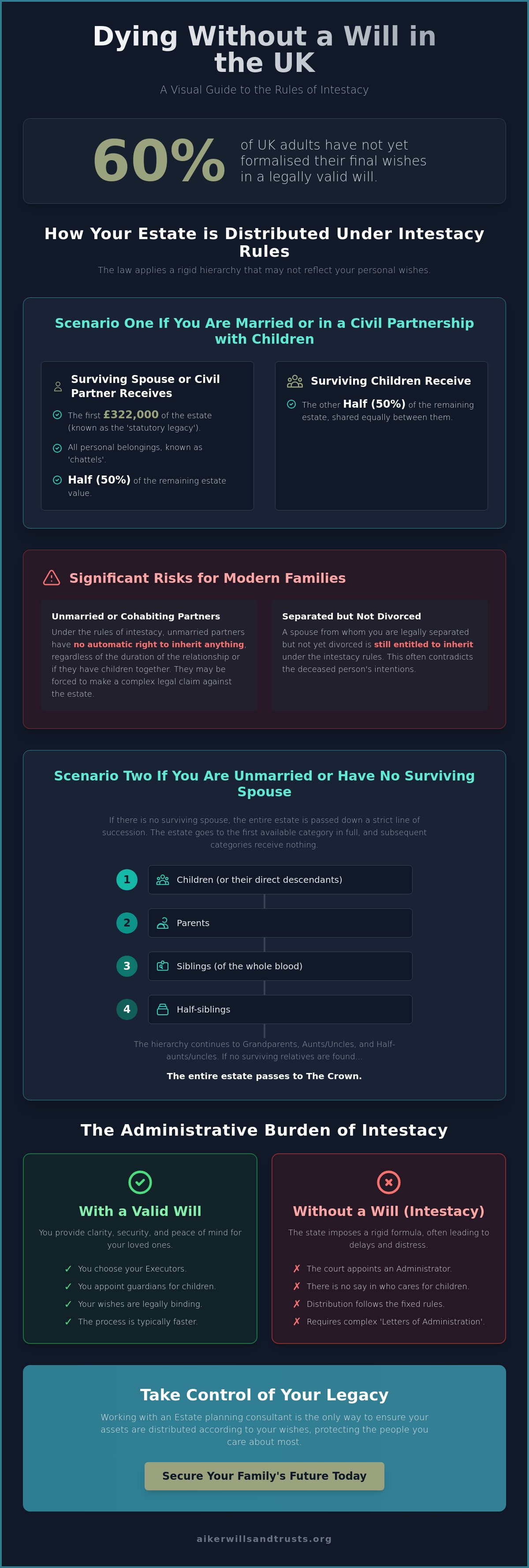
Did you know that approximately 60% of UK adults haven't yet formalised their final wishes?
It's a startling figure, especially when you consider how the rules for dying without a will actually work in practice.
Many of us assume our assets will naturally pass to those we love most, but without a clear plan, the law steps in with a rigid hierarchy that doesn't always account for the nuances of modern life. This can leave families facing unexpected hurdles during an already difficult time.
We understand that thinking about these transitions can feel uncomfortable or even overwhelming. It's completely natural to worry about potential family disputes or feel anxious that an unmarried partner might be left without legal protection.
This guide will help you discover how the laws of intestacy distribute assets and why professional planning is vital for modern families.
We'll walk through the current statutory legacy limits, explain how the probate process works, and show you how an Estate planning consultant can help you secure lasting peace of mind for your loved ones.
By understanding these rules, you can take a proactive step toward protecting your family's future and ensuring your intentions are respected.
Key Takeaways
- Understand how the state implements a default distribution plan if you haven't made a will, which often fails to reflect your personal intentions.
- Learn about the rigid hierarchy of the dying without a will rules UK, including the specific £322,000 threshold that impacts surviving spouses and children.
- Recognise the significant legal risks faced by unmarried partners and cohabiting couples who have no automatic inheritance rights under current legislation.
- Discover why applying for Letters of Administration often leads to more complex procedures and longer delays compared to the standard probate process.
- See how working with an Estate planning consultant to create a Single or Mirror Will provides your family with immediate clarity and lasting security.
Table of Contents
- What Happens When Someone Dies Intestate in the UK
- The Rigid Hierarchy of the Intestacy Rules
- Why Modern Families Face Greater Risks Under Intestacy
- The Practical Burden of Managing an Intestate Estate
- How Professional Estate Planning Protects Your Legacy
To learn more about securing your family's future, please contact our team at Aiker Wills and Trusts.
What Happens When Someone Dies Intestate in the UK
Life’s journey is often defined by the milestones we reach and the family we nurture along the way. Whilst we naturally focus on the present, ensuring our long-term achievements are preserved is vital to protecting those we love.
When a person passes away without leaving a valid will, they are legally described as an intestate person. In these instances, the dying without a will rules in the UK take effect, acting as a rigid, statutory framework that dictates how your estate is handled by the state.
The Legal Definition of Intestacy
Intestacy occurs not only when no will exists, but also if a document is found to be legally invalid or doesn't account for the entirety of an individual's assets.
These rules are strictly statutory and follow a fixed set of rules of succession that cannot be easily altered or bypassed once someone has passed away. It's helpful to view these regulations as a generic, one-size-fits-all template that the state applies to everyone. Whilst it provides a basic legal structure, it rarely reflects the unique nuances of modern family life or your specific personal intentions.
Why the Rules of Intestacy Exist
The rules act as a default safety net designed to prevent estates from falling into a legal vacuum. Without this framework, assets could remain in limbo for years, causing significant distress and confusion for grieving relatives.
However, because this is a standard system, it prevents you from choosing your own executors. Instead of a trusted friend or family member, the court appoints an administrator to oversee the process.
This person is responsible for managing your entire estate, which encompasses everything from your home and savings to your most cherished personal belongings.
Relying on this default system means you lose the power to make essential decisions, such as appointing guardians for your children or ensuring sentimental items reach specific people.
The state's plan is transactional and clinical, whereas your life is rich with personal history and complex relationships. By understanding how the rules on dying without a will in the UK might affect your specific circumstances, you can take proactive steps to replace this rigid legal formula with a plan that truly honours your intentions.
Working with an Estate planning consultant ensures you aren't just another case file, providing your family with the security they deserve and the peace of mind that comes from a bespoke strategy.
For personalised guidance on navigating these complex regulations, please get in touch with our team.
The Rigid Hierarchy of the Intestacy Rules
When a person passes away without a valid will, the law applies a fixed priority list to determine who should receive their assets. This system is often described as a ladder of inheritance, where each rung must be exhausted before the next group of relatives is considered.
The intestacy rules in England and Wales are designed for administrative efficiency rather than personal sentiment, which means the outcome can sometimes feel clinical or even unfair to those left behind. Understanding this hierarchy is the first step toward regaining control over your family's future security.
Inheritance for Spouses and Civil Partners
Under current legislation, only a person who was legally married or in a civil partnership with the deceased at the time of death is recognised as a primary beneficiary. A common source of distress involves couples who are separated but not yet legally divorced.
In these cases, the surviving partner is still entitled to inherit under the intestacy rules, regardless of how long they have lived apart or the state of their relationship. For those seeking the official government breakdown, the guide on Intestacy - who inherits if someone dies without a will? provides a useful starting point for understanding these legal boundaries.
If the estate is valued at more than £322,000 and there are surviving children, the spouse or civil partner receives a specific portion known as the statutory legacy. This currently consists of the first £322,000 of the estate, all personal belongings, and half of any remaining assets.
The other half of the surplus is then shared equally amongst the children. If the estate is worth less than this threshold, the surviving spouse or civil partner inherits everything, leaving other relatives with no legal claim to the assets.
The Rights of Children and Other Relatives
The definition of a child under these rules is strictly legal. It includes biological children and those who have been legally adopted, all of whom inherit equal shares of the portion allocated to them.
However, stepchildren are entirely excluded from the intestacy hierarchy unless they have been formalised through a legal adoption process. This often comes as a shock to blended families where stepchildren have been raised as part of the core family unit for many years.
If a child has already passed away, their children (the deceased's grandchildren) will typically inherit their parent's share.
When there is no surviving spouse or child, the estate follows a wider search for relatives. The order of priority moves to parents, then full-blood siblings, followed by half-siblings, and eventually grandparents or aunts and uncles.
If no qualifying relatives can be found, the entire estate passes to the Crown, a scenario known as bona vacantia. To ensure your hard-earned assets support the people you truly care about, you might consider arranging a consultation with an Estate planning consultant to discuss a more personal approach.
For personalised advice on protecting your unique family structure, please speak with one of our specialists.
Why Modern Families Face Greater Risks Under Intestacy
Modern British life has changed significantly over the last few decades. Whilst family structures have become more diverse and inclusive, the legal framework governing inheritance remains largely rooted in the past. This disconnect creates a precarious situation for many, as the dying without a will rules the UK don't adapt to the emotional realities of your household.
When the law steps in, it applies a clinical formula that fails to recognise the bonds of love and shared history that define your life.
One of the most persistent and dangerous misconceptions is the idea of a common law marriage. Many couples believe that living together for several years or having children together grants them the same legal protections as a married couple.
In reality, no such legal status exists in England and Wales. This misunderstanding often leads to heartbreaking outcomes where a surviving partner has no automatic right to stay in their family home or access shared savings.
For a deeper look at these consequences, the resource on Understanding the Rules of Intestacy highlights how these rigid regulations can leave modern families exposed.
The Vulnerability of Unmarried Partners
Cohabiting partners are particularly at risk under these outdated rules. If you own a property together as tenants in common, your share doesn't automatically pass to your partner. Instead, it follows the state's hierarchy, which could force your partner to sell the home to pay out other legal relatives.
This creates immense anxiety during an already difficult period of grief. An Estate planning consultant can help you avoid this by drafting a Single Will that clearly defines your intentions for your home and assets, providing the security your partner needs.
Challenges for Blended Families and Stepchildren
Blended families also face unique hurdles that the state simply doesn't account for. As we explored in the previous section, stepchildren have no legal standing under intestacy rules, no matter how close your relationship was. There is also the risk of sideways disinheritance.
This happens when assets pass to a surviving spouse and then, eventually, to that spouse's biological children, inadvertently excluding your own children from a previous relationship. Utilising family trusts ensures that every member of your family is treated fairly and with respect.
If no qualifying blood relatives can be located, your entire estate could eventually pass to the Crown under the principle of bona vacantia.
It's a sobering thought that a lifetime of hard work could end up in state coffers simply due to a lack of formal planning. Taking a proactive approach today ensures your legacy remains within the family you've nurtured and protected.
To learn more about how we can support your family through these transitions, please visit our contact page.
The Practical Burden of Managing an Intestate Estate
Losing a loved one is a period of profound emotional transition. When you add a layer of legal complexity to this grief, the burden can feel overwhelming for those left behind. Dying without a will in the UK don't just dictate who inherits; they also determine how the estate is managed.
Without a clear set of instructions, your family is often forced into a more complicated and time-consuming administrative process that can drain both emotional energy and financial resources.
It's a situation that requires a calm, protective approach to ensure your long-term achievements are preserved for the next generation.
Letters of Administration and Probate
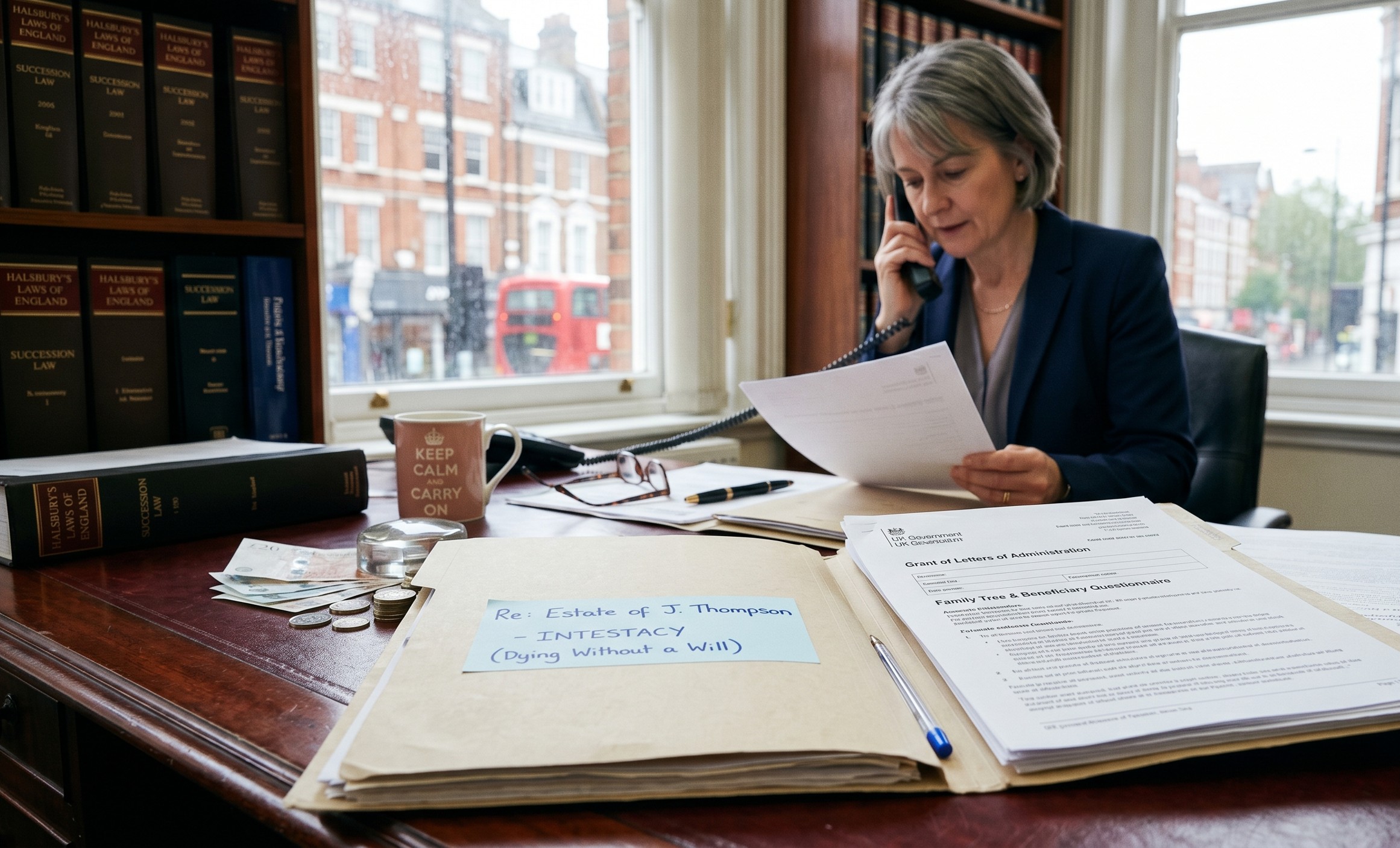
When a valid will exists, the named executors apply for a Grant of Probate to manage the estate. However, in cases of intestacy, there are no appointed executors. Instead, a family member must step forward to apply for Letters of Administration.
This legal document grants them the authority to manage your affairs, but the process of obtaining it is often more rigorous and prone to significant delays.
The person who takes on this role becomes personally liable for any mistakes made in the distribution of assets, placing immense pressure on their shoulders during an already difficult time.
Our professional executor service and probate support are designed to alleviate this stress. We work collaboratively with legal professionals to ensure every detail is handled with precision and care. By providing this level of professional oversight, we protect your family from the administrative pitfalls that frequently occur when a person passes away intestate.
It's a supportive approach that turns a cold legal requirement into a guided, manageable journey for your loved ones.
Potential for Family Disputes and Claims
One of the most distressing consequences of intestacy is the increased likelihood of conflict. When the distribution of assets feels unfair or fails to account for a dependant's needs, it can lead to long-lasting family rifts. Under the Inheritance Provision for Family and Dependants Act 1975, certain individuals can make a claim against the estate if they feel they haven't been reasonably provided for.
These legal challenges are not only emotionally draining but also significantly more expensive than a standard probate application. An Estate planning consultant acts as a guardian for your family's harmony, preventing these disputes before they even begin. To ensure your legacy is managed with the sensitivity it deserves, please reach out to us for a private consultation.
To ensure your family is protected by a bespoke strategy, please reach out to our dedicated team.
How Professional Estate Planning Protects Your Legacy
Life is a collection of achievements, relationships, and the hard work we invest to provide for those we love. Whilst the dying without a will rules UK offer a basic legal framework, they cannot replace the thoughtful, personalised touch of a bespoke estate plan.
Transitioning from a state-mandated formula to a proactive strategy allows you to act as the guardian of your family's future.
By taking control today, you replace uncertainty with a clear, legally robust roadmap that ensures your intentions are honoured exactly as you wish.
An Estate planning consultant provides more than just a document; they offer a supportive partnership rooted in mental tranquillity.
So, whether you choose a Single Will or a Mirror Will, these instruments provide immediate clarity for your loved ones. They remove the administrative burden we discussed earlier and ensure that your assets reach the right people without the delays and costs associated with intestacy. This level of professional oversight distinguishes a secure legacy from an unpredictable one.
Beyond a Simple Will
For many families, a standard will is only the beginning of a comprehensive protective strategy. A Family Asset Protection Trust offers a level of security that a simple will alone cannot provide.
These structures are designed to safeguard your property and savings from third-party claims or the rising costs of long-term care. If you are particularly concerned about ensuring your home remains a sanctuary for your descendants, a Protective Will Property Trust can be integrated into your plan.
Professional drafting ensures these documents are resilient against challenges, providing a steady presence in an unpredictable legal environment.
Securing Peace of Mind for the Future
The true value of estate planning lies in the peace of mind it brings to your daily life. Knowing that you've bypassed the rigid dying without a will rules in the UK allows you to focus on the present, secure in the knowledge that your family's harmony is protected.
We believe in a lifelong advisory relationship, which is why we encourage regular reviews of your estate plans. As your family grows or your personal circumstances evolve, your plan should remain a faithful reflection of your current intentions.
The process of securing your legacy is far simpler and more reassuring than many expect. With the guidance of a dedicated advisor, you can navigate the complexities of modern life and various personal structures with ease.
It's a compassionate investment in your family's welfare that turns potential worry into a state of resolution. We invite you to book a private consultation to begin building a future that is as unique and enduring as the life you've built.
To ensure your family is protected by a bespoke strategy, please reach out to our dedicated team.
Securing Your Family Legacy Today
Understanding the dying without a will rules UK is the first step toward reclaiming control over your family's future. As we've explored, the state's default hierarchy often fails to protect unmarried partners or account for the complexities of modern blended families.
By replacing this rigid legal formula with a bespoke plan, you ensure your long-term achievements remain a source of security rather than a cause for administrative distress. It's about moving from a state of potential worry to a position of absolute resolution.
Our expert estate planning consultants in Wrexham are here to guide you through every stage of this transition. Whether you require a specialist in a Protective Will Property Trust or need support from our Professional Executor Service & Probate, we provide a calm, protective environment for these vital conversations.
Contact an estate planning consultant today to protect your family's future and replace uncertainty with a clear, supportive roadmap. Taking this proactive step today is a profound act of care that offers your loved ones lasting tranquillity and ensures your intentions are honoured for years to come.
Frequently Asked Questions
What happens to my house if I die without a will and I am unmarried?
An unmarried partner has no automatic legal right to inherit a house under the rules of dying without a will in the UK. If you own the property in your sole name or as tenants in common, your interest will pass to your closest blood relatives according to the statutory hierarchy.
This often leaves surviving partners in a vulnerable position, potentially facing a forced sale of the home to satisfy the legal claims of other relatives.
Can my stepchildren inherit if there is no will in the UK?
Stepchildren do not have any automatic right to inherit from a stepparent's estate unless they have been legally adopted. The law prioritises biological children and those formalised through adoption, meaning even a lifelong emotional bond is not recognised by the state's default rules.
To ensure stepchildren are provided for, it is essential to work with an Estate planning consultant to draft a bespoke will that explicitly includes them.
How much does the spouse inherit under the rules of intestacy in 2026?
In 2026, a surviving spouse or civil partner is entitled to the first £322,000 of the estate, along with all personal belongings. If the deceased also left children, the spouse receives half of any assets valued above this £322,000 threshold, whilst the children share the remaining half equally.
If there are no surviving children, the spouse or civil partner inherits the entire estate regardless of its total value.
Who is responsible for managing the estate if no will was left?
When no will exists, the responsibility for managing the estate falls to a person known as an administrator. This individual must apply to the court for Letters of Administration to gain the legal authority to handle your affairs.
Usually, the closest living relative, such as a spouse or adult child, takes on this role. It is a significant administrative burden that carries personal legal liability for any errors made during the process.
What happens if I die without a will and have no living relatives?
If you pass away without a valid will and have no living relatives who qualify under the rules of succession, your entire estate passes to the Crown. This legal process is known as bona vacantia, which literally means vacant goods.
It is a sobering outcome for those who would have preferred their hard-earned assets to support a close friend, an unmarried partner, or a favourite charity instead of the state.
Does a civil partner have the same rights as a spouse under intestacy rules?
Yes, a civil partner has the exact same legal inheritance rights as a spouse under the current rules of intestacy. The law treats civil partnerships and marriages identically in this regard, ensuring that the surviving partner receives the statutory legacy and a share of the remaining assets.
However, this protection only applies to those who have formalised their relationship through a legal ceremony, leaving cohabiting couples without these essential safeguards.
Can the rules of intestacy be changed after someone has died?
The distribution of an intestate estate can sometimes be altered after death through a legal document called a Deed of Variation. This allows the beneficiaries to change how the assets are shared, perhaps to provide for an unmarried partner or a stepchild who was excluded.
However, this is only possible if every person who would have inherited under the original rules agrees to the changes, which can be difficult to achieve.
How long does it take to settle an estate when there is no will?
Settling an estate without a will typically takes longer than a standard probate process, often lasting between six and twelve months. The delay occurs because the family must first identify the correct administrator and then conduct a thorough search for all potential beneficiaries.
In complex cases where relatives are difficult to locate or family disputes arise, the process can extend even further, causing additional stress and increasing the final legal costs.

Article by
Jon Ainge
Jon has over 15 years’ experience in financial services and has helped raise over £50 million for charity. As a director and co-founder of Aiker Wills & Trusts, a trading style of FCA-regulated Elsworth Associates, John aims to help clients protect their legacy through specialist estate planning.
Disclaimer
Please note that the information provided is for general guidance only and should not be taken as professional financial advice tailored to your specific circumstances.
Talk to your Aiker Legacy Adviser
Arrange a home visit now to discuss your current situation, and which options might suit you best, and how regular reviews can help you be sure your legacy isn’t at risk. The whole process is easy, and starts by simply giving us your details.
Recent Posts

How to Register a Lasting Power of Attorney for Your Future Security?
Did you know that 15% of all applications to register a lasting power of attorney contain errors that lead to significant delays and potential rejection...

Power of Attorney for Elderly Parents in North Wales
Did you know that an estimated 85% of UK adults have not yet put a Lasting Power of Attorney in place?It is a startling figure, especially when you...

Business LPAs, How to Protect Your Company Today
If you were suddenly unable to attend your office in tomorrow, would your company be able to pay its staff or settle its invoices by the end of the...

A Comprehensive Guide to the Family Asset Protection Trust in the UK
You spend a lifetime paying off your mortgage and maintaining your home, only to realise that a single change in your health could see that property...

Professional Single Person Will Services to Secure Your Legacy
Did you know that over 56% of UK adults currently do not have a valid will? For many people living, the thought of discussing what happens after we...
Understanding the Rules for Dying Without a Will in the UK
Did you know that approximately 60% of UK adults haven't yet formalised their final wishes?It's a startling figure, especially when you consider how the...