





Home > Latest News > A Comprehensive Guide to the Family Asset Protection Trust in the UK
A Comprehensive Guide to the Family Asset Protection Trust in the UK
Date added: 17/06/26
You spend a lifetime paying off your mortgage and maintaining your home, only to realise that a single change in your health could see that property sold to cover care costs.
It is a distressing scenario that many UK families now face, especially as inheritance tax thresholds remain frozen until at least 2030. You likely feel that the wealth you have built should stay within your family, which is why a Family Asset Protection Trusts has become such a vital tool for those seeking to safeguard their children's future from the 40% tax rate and the anxieties of the probate process.
Please note: Transfers of property / assets into a lifetime discretionary trust that exceed an individual's available nil-rate band (£325,000) are subject to an immediate 20% Lifetime Inheritance Tax entry charge, plus potential 10-year anniversary and exit charges as well.
We believe in preserving your history and the mental tranquillity that comes with a certain future. By reading this guide, you will discover how a Family Asset Protection Trusts can secure your legacy and provide long-term peace of mind for your loved ones.
We will explore how these structures function under current UK regulations, ensuring your estate is legally compliant and your children's inheritance is secure.
You'll learn how to simplify these transitions with the professional oversight of an Estate planning consultant, moving from a state of worry to one of total resolution.
Key Takeaways
- Learn how a Family Asset Protection Trusts acts as a legal shield, allowing trustees to manage your assets for the benefit of your loved ones whilst you maintain professional oversight.
- Discover the practical ways these structures allow your estate to bypass the lengthy probate process, ensuring your family receives their inheritance without unnecessary delay.
- Gain clarity on the complex rules surrounding the deprivation of assets to understand how proactive planning can legitimately protect your home from future care costs.
- Understand the specific differences between various trust models to determine which level of security best suits your unique family circumstances and long-term goals.
- Follow a clear path to securing your legacy, starting with a comprehensive fact-finding session alongside a dedicated Estate planning consultant.
Table of Contents
- Key Takeaways
- Understanding the Family Asset Protection Trusts
- The Core Benefits of Establishing a Trust Structure
- Navigating the Complexities of Asset Deprivation Rules
- Comparing Asset Protection Trusts with Other Protective Measures
- The Essential Steps to Establishing a Secure Trust
- Securing Your Family Legacy for the Long Term
- Frequently Asked Questions
- Disclaimer
If you would like to discuss your specific circumstances with a professional, please get in touch with our team for a private consultation.
Understanding the Family Asset Protection Trusts
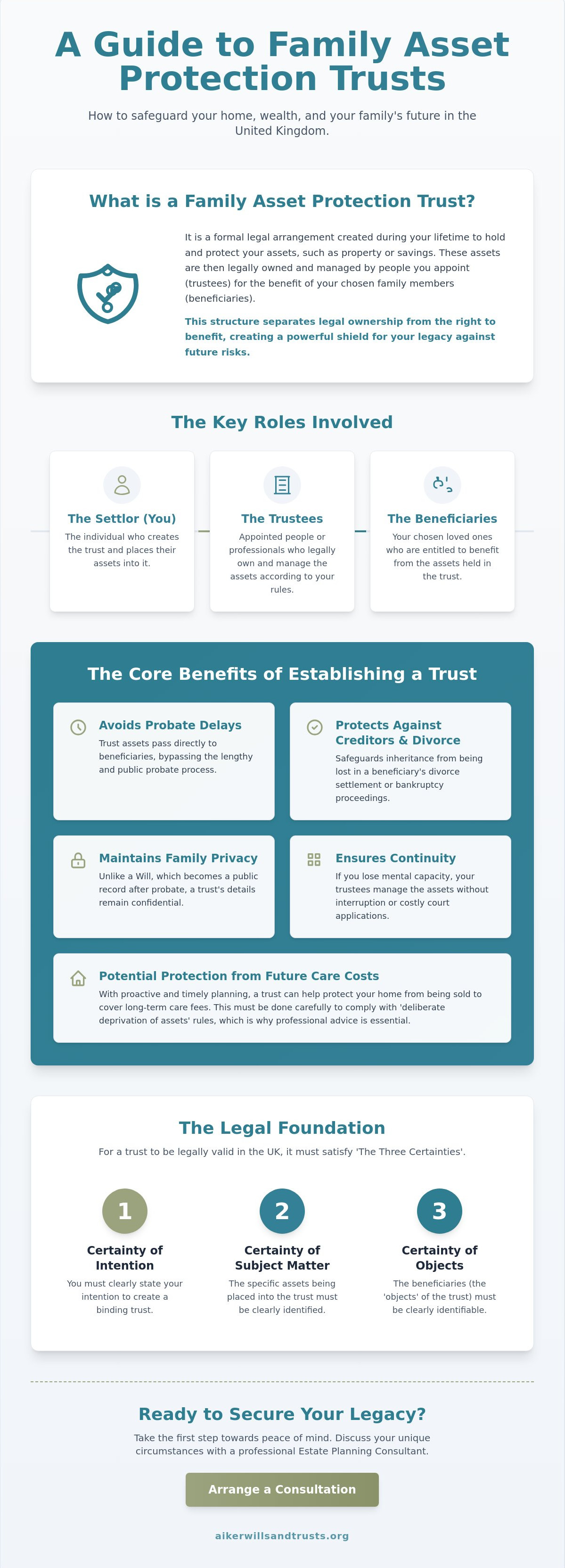
A Family Asset Protection Trust is a formal legal arrangement designed to safeguard your hard-earned wealth for future generations. It functions by separating the legal ownership of your property or savings from the right to benefit from them.
Unlike trusts created within a Will, which only take effect upon death, this is a lifetime trust established while you are still alive to see your intentions put into place. To be valid under English law, the structure must meet the three certainties.
These are certainty of intention, certainty of subject matter, and certainty of objects. This means you must clearly intend to create a trust, specify exactly which assets are included, and identify who is to benefit from them. The settlor is the individual who transfers their assets into the trust and defines the specific rules by which the arrangement must be governed.
The concept of an Asset-protection trust has long been a cornerstone of sophisticated financial planning. It provides a robust framework to shield property and savings from various external risks while ensuring the settlor’s wishes are respected over the long term.

The Legal Structure and Primary Roles
- Trustees are the individuals or professional entities responsible for the day-to-day management of the trust assets. They have a fiduciary duty to act in the best interests of the beneficiaries, ensuring the fund is managed in accordance with your wishes.
- Beneficiaries typically include children, grandchildren, or other family members who are entitled to receive income or capital from the trust.
A crucial element of this structure is the separation of ownership. Trustees hold the legal title to the property, while the beneficiaries hold the beneficial interest. This distinction ensures that the assets are protected from the personal liabilities or financial difficulties of any single individual. It creates a steady presence in an unpredictable environment.
Why Families Choose This Protective Structure
Many families choose this path because they want to ensure their wealth remains within the family bloodline. Life is unpredictable. Relationships may change, and unexpected financial pressures can arise.
By placing assets in a trust, you ensure they are protected from divorce settlements or bankruptcy involving your heirs. It is also an effective way to manage wealth for younger family members who might not yet be ready for the responsibility that comes with a large inheritance. Working with a qualified Estate planning consultant allows you to identify your family's unique needs and tailor the trust to meet those specific requirements. This professional oversight provides the mental tranquillity that your legacy is secure and your children are protected.
If you have questions about how these benefits apply to your family, you can speak with one of our specialists for personalised guidance.
The Core Benefits of Establishing a Trust Structure
Establishing a Family Asset Protection Trusts provides a layer of security that traditional Wills simply cannot match. One of the most significant advantages is the preservation of privacy. Unlike a Will, which becomes a public document once probate is granted, a trust remains a private arrangement.
This means the details of your assets and who receives them aren't available for public scrutiny. Beyond privacy, these structures offer a robust defence against beneficiaries' financial instability. If a loved one faces a difficult divorce or bankruptcy, assets held in the trust are generally protected from inclusion in those proceedings. This ensures your hard-earned success is used exactly as you intended.
There's also the vital benefit of continuity. If you were to lose mental capacity, your trustees can continue to manage the assets without the need for a lengthy and expensive application to the Court of Protection.
Streamlining the Probate Process
The UK probate process has faced significant delays in recent years. While some estimates suggest a 16-week timeframe, many families wait much longer to settle an estate. By placing your property into a trust, those assets bypass the probate process entirely.
This allows for the immediate distribution of funds or the continued occupation of a family home without legal interruption. We often work alongside our professional executor service and probate team to ensure that even the most complex estates are handled with care.
This collaborative approach removes the administrative burden from your grieving family, providing them with much-needed support during a difficult transition.
Protecting Your History and Legacy
There is a deep emotional value in knowing the family home is safe. A trust acts as a dedicated guardian for your life achievements, ensuring that what you've built isn't lost to external threats. Because tax laws and family circumstances evolve, it's essential to follow the UK government guidance on trusts and taxes to remain compliant.
Your Estate planning consultant plays a proactive role here, offering regular reviews to ensure the structure continues to meet your objectives. This ongoing relationship is what distinguishes a professional plan from a temporary fix.
For a confidential discussion regarding your property and potential care costs, please reach out to our experienced team.
Navigating the Complexities of Asset Deprivation Rules
A common worry for many families is the fear of losing their home to fund care costs in later life. This anxiety often leads people to consider a Family Asset Protection Trust, but it's vital to understand the rules surrounding the deliberate deprivation of assets.
According to UK government guidelines, this occurs when someone intentionally decreases their wealth to reduce the amount they have to pay towards care. If a local authority decides that the primary reason for setting up a trust was to avoid these fees, they may still treat the assets as if you still owned them.
To ensure your trust is robust, it must be established for multiple legitimate reasons, such as protecting your children's inheritance from divorce or ensuring a smoother probate process. Timing and motivation are the two critical factors that determine whether a trust will be viewed as a valid planning tool or a deprivation of assets.
The UK government's guide to types of trusts provides a useful foundation for understanding the different legal structures available. However, the way these rules are applied can feel unpredictable, which is why professional oversight is so important for maintaining your mental tranquillity.
Understanding Local Authority Assessments
Local authorities in areas such as Wrexham and across the country are tasked with evaluating asset transfers as part of financial assessments for care.
They use what is known as a foreseeability test to determine your intentions. If you were fit and healthy when you established the trust and had no reason to believe you would need care in the near future, the council is less likely to challenge the arrangement.
They look for transparency and honesty in your estate planning. Councils will scrutinise the records to see whether the transfer was a reasonable gift or a calculated move to shift the burden of care costs onto the state. This is why keeping detailed records of your motivations at the time of creation is essential for long-term security.
The Role of Professional Guidance in Compliance
Our estate planning consultants work in direct collaboration with our associated solicitors to ensure that every trust established is legally seamless. Because complex asset structures require both practical estate strategy and formal legal drafting, this joint approach ensures your trust is robust, fully compliant, and perfectly tailored to your long-term goals.
These kits often fail to account for the nuances of your financial situation, leaving your family vulnerable to future legal challenges. A professional audit of your current assets and a clear statement of your long-term goals can make all the difference. By taking a proactive and organised approach, you can ensure your legacy is protected by a structure that withstands professional scrutiny.
To find out which protective structure is most suitable for your family, please get in touch with us for a professional consultation.
Comparing Asset Protection Trusts with Other Protective Measures
Choosing the right vehicle for your legacy requires a clear understanding of the available options. While a Family Asset Protection Trust is a comprehensive solution for long-term security, it is often compared to a Standard Asset Trust. The primary difference lies in the breadth of protection. A standard trust is frequently used for specific, one-off asset transfers, whereas the family variant is designed to act as a robust, multi-generational vessel.
It provides a more flexible framework to adapt as your family grows and your circumstances change. Selecting between them depends on whether you are looking for a simple holding structure or a dedicated guardian for your entire family history.
Lifetime Trusts versus Will-Based Trusts
The most fundamental decision is when the trust should begin its work. Lifetime trusts are established immediately, providing protection from the moment assets are transferred. This offers the distinct advantage of bypassing probate entirely for those specific assets, as we discussed in earlier sections. On the other hand, trusts created within a Will, such as a Protective Will Property Trust, only come into effect upon your death.
These are often more appropriate for individuals who aren't yet ready to part with the legal title of their property but want to secure its future for their heirs.
Each path has unique tax implications. For example, following the 2025 Autumn Statement and subsequent budget updates leading into 2026, the standard individual CGT allowance sits at £3,000. Therefore, the maximum standard trust allowance is now £1,500.
As a result, your Estate planning consultant can help you weigh these immediate protections against the flexibility of a will-based structure.
Specialised Trusts for Unique Family Circumstances
Every family is different, and generic solutions rarely provide the mental tranquillity you deserve. If you have a disabled or vulnerable relative, a Vulnerable Persons Trust is often the most empathetic way to provide for them. A Vulnerable Persons Trust actually qualifies for the full individual allowance of £3,000.
This structure ensures they are cared for without losing their eligibility for essential state benefits. Families navigating second marriages also face unique challenges, particularly the desire to protect children from a first marriage, whilst still providing for a current spouse. In these cases, we often recommend a Severance of Tenancy. This process changes how you own your home, allowing you to leave your specific share to a trust rather than it automatically passing to the surviving co-owner.
It is a proactive way to ensure your children's inheritance remains secure within your bloodline.
Deciding on the best path for your loved ones shouldn't be a source of anxiety. We invite you to book a fact-finding session with us to explore which of these protective measures will best serve your family's future.
If you are ready to begin securing your family's future, please schedule a private consultation with us to discuss your requirements.
The Essential Steps to Establishing a Secure Trust
Establishing a Family Asset Protection Trust is a steady process that requires both care and professional diligence. It begins with a comprehensive fact-finding session where your Estate planning consultant takes the time to understand your unique family history and long-term intentions.
Once your goals are clear, the next step is to identify the specific assets to be protected, which, for most families, include the family home and significant savings. You then select and appoint trustworthy individuals to act as your trustees, and draft a trust deed under professional legal oversight to ensure its validity.
Finally, the trust must be registered with the HMRC Trust Registration Service. For taxable trusts created on or after 6 April 2021, this registration is usually required within 90 days of the trust becoming liable for tax. This structured approach moves you from potential worry to resolution.
Conducting a Thorough Estate Review
You cannot protect what you have not fully mapped out. A thorough review goes beyond a simple list of bank accounts and property values. It involves looking at your family dynamics, potential future changes, and your specific wishes for each beneficiary.
Our Estate planning consultants evaluate these factors alongside our legal team to ensure the structure is both compassionate and compliant. This collaborative process ensures that the resulting trust is not just a clinical document, but a living reflection of your desire for family security.
It allows us to identify any potential hurdles early, ensuring the plan remains robust against future challenges.
Choosing the Right Trustees for Your Family
Your trustees are the guardians of your legacy. When selecting them, you should look for individuals who demonstrate reliability, good judgment, and a reasonable level of financial literacy. Whilst many people choose close family members, there is also the option of appointing professional trustees to provide an additional layer of security and impartial oversight. Regardless of whom you choose, providing a clear letter of wishes is essential.
This document offers your trustees personal guidance on how you would like the trust managed in specific scenarios, bridging the gap between technical legal requirements and your human intentions. This ensures that your wealth is managed with the same care and values that you applied whilst building it.
If you are ready to take the next step in securing your estate, please contact our team to arrange a private consultation.
Securing Your Family Legacy for the Long Term
Planning for the future is a profound act of care for those you love. By choosing a Family Asset Protection Trusts, you ensure that your property and savings are shielded from the uncertainties of probate and the financial risks faced by future generations.
You've seen how this structure provides privacy and maintains the continuity of your estate, even in unpredictable times. Aiker Wills and Trusts is a trading style of Elsworth Associates Ltd, established in 2003, and we have spent decades providing the professional guidance that bridges the gap between complex legal requirements and your unique family needs.
Our focus is entirely on providing you with the mental tranquillity that comes from expert asset preservation. Your dedicated Estate planning consultant will work alongside you to ensure your intentions are clearly defined and legally robust. Don't leave your life achievements to chance. We invite you to book a consultation with an Estate planning consultant today to begin creating a secure plan for your loved ones. Your legacy deserves the protection of a steady, experienced partner who is committed to your family's lifelong welfare.
Frequently Asked Questions
What is a Family Asset Protection Trusts, and how does it work?
A Family Asset Protection Trusts is a legal structure in which you transfer ownership of your assets to trustees to hold them for the benefit of your loved ones. It works by separating the legal title of your property from the beneficial interest.
This ensures that whilst the assets are managed in accordance with your specific instructions, they are protected against external risks. It is a proactive way to secure your history and provide long-term security for your heirs.
Can a Family Asset Protection Trusts protect my home from care fees?
This structure can protect your home from care fees, provided it is established for multiple legitimate reasons and not solely to avoid care costs. Local authorities evaluate these transfers based on your health and the foreseeability of care needs at the time the trust was created.
If you are fit and healthy when the trust is established, it is much harder for a council to claim deliberate deprivation of assets. Professional guidance is essential here.
Who controls the assets once they are placed into a trust?
The trustees you appoint are responsible for the legal control and management of the trust assets. They have a fiduciary duty to act in the best interests of your beneficiaries and must follow the rules set out in your trust deed. You can often appoint yourself as a trustee alongside others to maintain some involvement.
This ensures your intentions for family welfare are carried out with the professional oversight you expect.
Are there any tax implications for setting up a family trust in the UK?
There are several tax considerations, including Inheritance Tax, Capital Gains Tax, and Income Tax. For the 2026 to 2027 tax year, the Capital Gains Tax annual exempt amount for trusts is £1,500.
Most trusts also need to be registered with the HMRC Trust Registration Service to remain compliant. Your Estate planning consultant will help you understand these requirements, ensuring your plan provides the mental tranquillity you need whilst meeting all legal obligations.
Is it possible to change the beneficiaries of a trust at a later date?
The ability to change beneficiaries depends on the specific type of trust you choose to establish. Discretionary trusts offer the most flexibility, allowing trustees to decide which beneficiaries receive support as family circumstances evolve. Other structures may have fixed beneficiaries that cannot be altered once the trust is active.
This is why we emphasise the need for regular reviews to ensure your protective structure continues to reflect your current family dynamics and long-term goals.
What is the difference between a family trust and a will?
A trust is a lifetime arrangement that takes effect immediately, whereas a Will only becomes active after you pass away. Assets held in a trust bypass the probate process entirely, which can save your family months of administrative delay and public scrutiny. Whilst a Will is a vital document for distributing your remaining estate, a trust acts as a dedicated guardian for specific assets, providing a more robust level of protection during your lifetime and beyond.
Do I need a solicitor to set up a Family Asset Protection Trusts?
Professional legal oversight is vital to ensure your trust deed is valid and capable of withstanding scrutiny. Our Estate planning consultants work in close collaboration with legal professionals to draft documents that meet the highest professional standards.
As a result, this integrated approach combines strategic asset preservation with formal legal expertise, giving your family complete security and peace of mind.
How much does it cost to maintain a trust over many years?
Ongoing costs depend on the complexity of your assets and whether you choose to appoint professional trustees. Common expenses include filing annual tax returns with HMRC and conducting periodic reviews to stay aligned with changing UK regulations.
Whilst there are administrative costs involved, most families find these are far outweighed by the protection of the family home and the savings made by avoiding the high costs associated with the traditional probate process.

Article by
Jon Ainge
Jon has over 15 years’ experience in financial services and has helped raise over £50 million for charity. As a director and co-founder of Aiker Wills & Trusts, a trading style of FCA-regulated Elsworth Associates, John aims to help clients protect their legacy through specialist estate planning.
Disclaimer
Please note that the information provided is for general guidance only and should not be taken as professional financial advice tailored to your specific circumstances.
Talk to your Aiker Legacy Adviser
Arrange a home visit now to discuss your current situation, and which options might suit you best, and how regular reviews can help you be sure your legacy isn’t at risk. The whole process is easy, and starts by simply giving us your details.
Recent Posts

Blended Family Estate Planning in 2026 and How to Protect Your Loved Ones
Did you know that over 40% of adults now have at least one step-relationship within their family circle? While modern families come in many beautiful...

Mirror Wills, Protecting Your Partner in North Wales
What if the legacy you've spent a lifetime building for your spouse and children ends up in the hands of a complete stranger?It's a heavy thought,...

Understanding the Rules for Dying Without a Will in the UK
Did you know that approximately 60% of UK adults haven't yet formalised their final wishes?It's a startling figure, especially when you consider how the...

How to Register a Lasting Power of Attorney for Your Future Security?
Did you know that 15% of all applications to register a lasting power of attorney contain errors that lead to significant delays and potential rejection...

Providing Security through a Vulnerable Persons Trust and Professional Estate Planning
Imagine the profound relief of knowing your child will always be supported, even when you are no longer there to manage their affairs.For many families...

What is an LPA? Why UK Families Need Protection
Imagine a sudden crisis where you are unable to speak for yourself, and your closest family members are told they have no legal right to manage your...