





Home > Latest News > What is an LPA? Why UK Families Need Protection
What is an LPA? Why UK Families Need Protection
Date added: 28/08/26
Imagine a sudden crisis where you are unable to speak for yourself, and your closest family members are told they have no legal right to manage your bank accounts or decide on your medical care.
It is a common misconception amongst families in UK that a spouse or adult child can automatically step in as next of kin, yet without the right legal framework, your relatives may find themselves locked out of vital decisions.
Understanding what a Lasting Power Attorney (LPA) is and why you should have one in place is the first step toward securing your autonomy and protecting your family from unnecessary legal limbo.
We understand that planning for a time when you might lack mental capacity feels uncomfortable, but it is one of the most proactive ways to show care for those you love.
By reading on, you will discover how a Lasting Power of Attorney protects your future and why establishing one now is the most compassionate gift for your family.
We will provide total clarity on the legal necessity of these documents, explain the two different types of protection available, and help you find the peace of mind that comes from knowing your wishes will be honoured by an estate planning consultant you can trust.
Key Takeaways
- Gain a clear understanding of what a Lasting Power Attorney (LPA) is and why you should have one in place to safeguard your future autonomy and family.
- Learn about the two distinct types of protection and why combining them provides the most thorough security for both your health and your assets.
- Uncover the truth about the next of kin myth and how to prevent your loved ones from being locked out of vital medical or financial choices.
- Compare the speed and affordability of an LPA against the complex and expensive alternative of a court-appointed Deputyship order.
- Discover how an Estate planning consultant provides the professional oversight needed to ensure your intentions are respected, and your family is fully supported.
Table of Contents
-
Understanding what a Lasting Power of Attorney is and why it matters
-
Exploring the two distinct types of LPA for comprehensive protection
-
Addressing the next of kin misconception and other common myths
-
How an Estate planning consultant guides you through the process
To discuss your future planning with a specialist, please book a consultation with our team.
Understanding what a Lasting Power of Attorney is and why it matters
Life is often a sequence of carefully planned events, but sometimes the unexpected intervenes.
Whilst many people believe that legal planning is only for the elderly, the reality is that mental capacity can be lost at any age. Whether it's a sudden accident or a gradual illness like dementia, the ability to communicate our wishes can disappear without warning.
When families ask what a Lasting Power Attorney (LPA) is and why they should have one in place, the answer is simple; it's about maintaining control over your own story when you can no longer tell it yourself.
Under the framework of the Mental Capacity Act 2005, a Lasting Power of Attorney (LPA) is a legal document that allows you to appoint trusted individuals, known as your attorneys, to act on your behalf.
Think of it as a dormant safety net. It sits quietly in the background, registered and ready, but it only becomes active if you lose the ability to make your own choices. It ensures that the people you trust most are the ones holding the keys to your future, rather than leaving those decisions to strangers or the state.
Having a Lasting Power of Attorney in place provides the ultimate reassurance that your values will be upheld.
The legal foundation of an LPA
The Office of the Public Guardian oversees the registration and regulation of these documents to ensure they are used correctly and ethically. It's a common fear that signing an LPA immediately surrenders your independence.
This is simply not the case. You are choosing who will uphold your rights and values if you can no longer do so yourself.
This proactive choice is vastly different from a reactive court order, where a judge who doesn't know you decides who should manage your life after you have already lost capacity.
It's a transition from being a passive subject of the law to an active architect of your own protection.
Why waiting can be a costly mistake
There is a very specific window of opportunity for creating a valid legal document. An LPA is only legally binding if it is created whilst you still have the full mental capacity to understand the choices you are making. If you wait until a crisis occurs, that window often slams shut.
The donor is the individual who creates the document to appoint trusted people to manage their affairs. If capacity is lost before this document is signed and registered, your family might find themselves facing a complex legal battle to regain control over your care and finances.
An Estate planning consultant can help you navigate these requirements before a crisis makes the decision for you.
For personalised guidance on choosing the right protection for your family, reach out to our consultants today.
Exploring the two distinct types of LPA for comprehensive protection
When people ask what a Lasting Power Attorney (LPA) is and why they should have one in place, they are often surprised to learn that a single document does not cover everything. UK law divides your life into two distinct categories: your money and your body.
To ensure you are fully protected, you need two separate documents that work in harmony to safeguard your future.
These are not just legal forms; they are the blueprints for how you wish to be treated when you can no longer voice your own decisions. Relying on just one type can leave significant gaps in your security, which is why most families choose to establish both simultaneously.
It's vital to understand that the registration process is not instantaneous. According to the official government guidance on LPAs, it currently takes between 8 and 10 weeks for the Office of the Public Guardian to process and register these documents.
This timeframe highlights why waiting for a crisis is a risky strategy. You must also think carefully about who you appoint.
Your attorneys should be individuals who not only have the practical skills to manage your affairs but who also deeply understand and respect your personal values and history.
If you are unsure which role your chosen attorney should take, speaking with a specialist can provide the clarity you need.
The Property and Financial Affairs LPA
This document authorises your attorneys to manage your finances. It covers everything from paying your monthly utility bills and managing your pension to the more significant task of selling your property if you need to fund care.
One unique feature of this type is that, with your explicit permission, it can be used whilst you still have mental capacity. This is particularly helpful for those who may be physically frail or prefer to have a loved one handle complex banking tasks.
You can find more specific details on how this works on our Lasting Power of Attorney service page.
The Health and Welfare LPA
Unlike the financial version, a Health and Welfare LPA only ever comes into effect once a medical professional has confirmed you have lost the capacity to decide for yourself. It empowers your attorneys to make choices about your daily routine, your medical treatments, and even where you live.
Perhaps most importantly, it allows you to give your attorneys the power to make decisions regarding life-sustaining care. Having this in place removes a heavy emotional burden from your family.
They won't have to guess what you would have wanted during a medical crisis because you have already given them the legal authority and the moral direction to act on your behalf.
To ensure your family is fully protected from legal complications, get in touch with our team for expert advice.

Addressing the next of kin misconception and other common myths
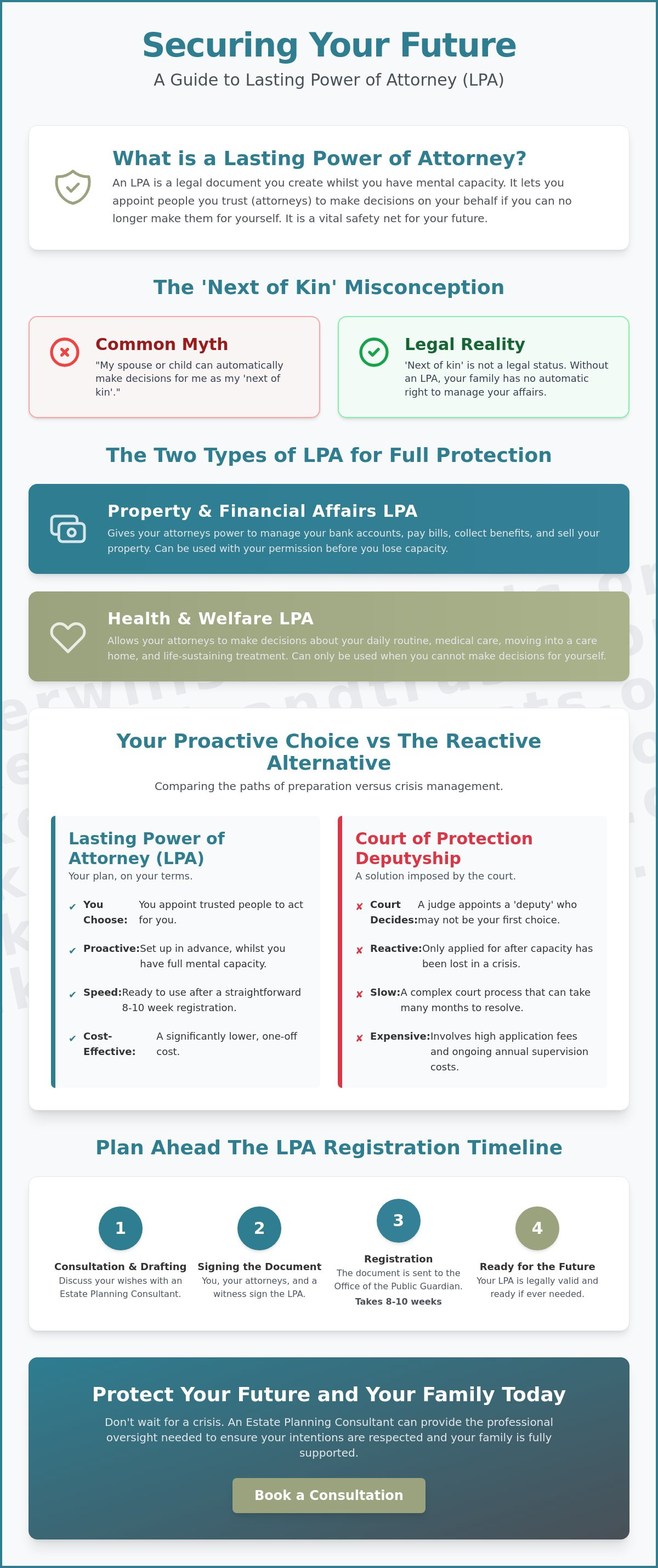
The term next of kin is used so frequently in hospitals and on official forms that many families in UK assume it carries significant legal weight. It is perhaps the most common and dangerous misconception in estate planning.
Many believe that being a spouse or child automatically grants them the right to step in and make decisions if a loved one loses capacity. In reality, the modern UK legal system views next of kin as a point of contact rather than a grant of authority.
Without a Lasting Power of Attorney (LPA), the legal right to decide on your welfare or finances often shifts to social services or medical professionals.
This can leave your family feeling helpless during a crisis, unable to influence the most personal aspects of your care.
Understanding what a Lasting Power Attorney (LPA) is and why you should have one in place is about reclaiming that authority for your family. It is not an admission of weakness or a sign of ageing; it is a collaborative act of love that provides total clarity for everyone involved.
By choosing your attorneys now, you are sparing your relatives the anxiety of navigating a system that might otherwise exclude them.
Discussing these options with an Estate planning consultant ensures that your family remains the primary voice in your future, regardless of what life may bring.
What happens to joint bank accounts
There is a widespread belief that a joint bank account is always accessible to both parties.
However, if one account holder loses mental capacity and no LPA is registered, the bank may freeze the account to protect the vulnerable person's assets. This often causes immediate practical hardship for a healthy spouse who needs those funds to pay household bills or the mortgage.
Marriage does not automatically grant the right to manage a partner's financial affairs in the UK. Having a Property and Financial Affairs LPA in place ensures the bank recognises your attorney's authority, preventing an administrative nightmare during an already stressful time.
The limits of medical consultation
Whilst medical teams are generally excellent at consulting with families, they are not legally bound to follow your family's wishes without a Health and Welfare LPA. In the absence of this document, the final decision regarding medical treatments or care arrangements rests with the doctors based on their assessment of your best interests.
This can lead to disputes and additional trauma for your loved ones if they disagree with a proposed plan. A Health and Welfare LPA places your family back at the centre of the decision-making process, giving them the legal standing to ensure your specific preferences and values are honoured.
To learn more about how you can protect your loved ones from the complexities of court intervention, please book a review with our team.
Comparing an LPA with the alternative of a Deputyship order
When legal protection is not arranged in advance, the law provides a reactive solution: a Deputyship order.
This is the path families must take through the Court of Protection if a loved one loses mental capacity without having a valid LPA already registered. Whilst this system exists to protect vulnerable individuals, it is a far more clinical and bureaucratic process than the private arrangement of an LPA.
Understanding what a Lasting Power Attorney (LPA) is and why you should have one in place is essentially about choosing the easy path over the difficult one.
It is the difference between you selecting a trusted guardian and having a judge appoint a deputy to manage your life.
A Deputyship order is often seen as a last resort because it strips away the element of personal choice. When you create an LPA, you are the architect of your own future.
You decide who understands your values and who will act with your best interests at heart. In contrast, a court-appointed deputy is subject to ongoing supervision and must pay annual fees to the Office of the Public Guardian.
This creates a lifelong administrative relationship with the state that many families find intrusive. Integrating an LPA into a wider strategy that includes a Professional Executor Service & Probate ensures that every stage of your future is handled with professional oversight and care.
The cost and time implications
The practical differences between these two routes are stark. Setting up an LPA is significantly cheaper and more efficient than the alternative. Research from 2026 indicates that obtaining a Deputyship order is a much slower process, often taking 40 weeks or more.
During this long wait, bank accounts and assets can remain frozen, leaving families unable to pay for essential care or household costs. There is also the risk that a court may not appoint the person you would have favoured, potentially leading to family friction during an already sensitive time.
Choosing to act now avoids these delays and ensures that your chosen representatives can step in the moment they are needed.
The burden of court supervision
Being a deputy is a significant responsibility that comes with heavy reporting requirements. Every year, a deputy must submit a detailed report to the Office of the Public Guardian, accounting for every penny spent and every major decision made.
This level of scrutiny is designed to prevent abuse, but it adds a layer of stress to family members who are already coping with a loved one's illness.
An LPA allows for a more private and less bureaucratic management of your affairs, based on the trust you have already established with your solicitors. It is truly a gift of simplicity for those you leave in charge.
To ensure your family is never burdened by court-mandated reporting, secure your family's future today.
If you are ready to begin your planning journey, please book a consultation with our specialist team.
How an Estate planning consultant guides you through the process
The process of creating a legal document can often feel like a daunting administrative hurdle.
This is where the expertise of an Estate planning consultant becomes invaluable, acting as a supportive guide through the intricate details of the application. Their role is to transform a complex legal requirement into a clear, manageable plan that reflects your unique circumstances.
For residents in UK and the surrounding areas, we offer a personalised home visit service, allowing you to discuss these sensitive topics in the comfort and privacy of your own living room.
This human-centric approach ensures that you feel heard and understood, rather than processed through a clinical system.
Understanding what a Lasting Power Attorney (LPA) is and why you should have one in place is the foundation of a secure future, but the document is only as strong as its execution. Professional advice ensures that your LPA is robust and unlikely to be rejected by the Office of the Public Guardian due to technical errors or ambiguous wording.
An Estate planning consultant will also help you see the bigger picture, showing how an LPA fits into a wider strategy alongside Mirror Wills or Single Wills. This holistic view ensures that your legacy is protected both during your lifetime and after you have passed away.
Ensuring your documents are future-proof
The wording of your preferences and instructions within the LPA is critical. If these are too vague or legally incompatible, the document may not function as you intended when it is finally needed.
Professional oversight prevents the common errors that lead to lengthy registration delays or outright rejections.
We maintain a collaborative relationship with the legal profession, ensuring that our clients benefit from high professional standards whilst enjoying the accessible, empathetic service of an estate planner. This partnership guarantees that your intentions are translated into a legally sound structure that stands the test of time.
Taking the first step towards peace of mind
Viewing life planning as a positive step for your future security is a powerful shift in perspective.
It isn't about dwelling on life's difficult transitions, but rather about honouring the achievements you've worked so hard to build. The process begins with a simple initial consultation where we listen to your specific family needs and explain the solutions available to you.
You can rest assured that your legacy is in safe hands, supported by a team that is deeply committed to the continuity of your intentions. Taking this step today provides the mental tranquillity that comes from knowing you've protected those you love the most.
To begin protecting your family, please book an appointment with our specialist team.
Securing your family legacy in UK
Choosing to organise your affairs today is a profound act of care that removes the burden of uncertainty from those you love. We've explored how these documents act as a vital safety net, ensuring your voice is heard even if you're unable to speak for yourself. By gaining a full understanding of what a Lasting Power Attorney (LPA) is and why you should have one in place, you transition from a position of potential risk to one of total clarity and security.
Our professional Estate planning consultants based in UK provide specialist support for both Health and Financial LPAs, ensuring every nuance of your future is considered.
We take a collaborative approach to securing your family legacy, providing a robust framework that respects your lifelong achievements. This process is about more than just legal compliance; it's about the mental tranquillity that comes from knowing your wishes will be honoured.
Secure your future and protect your loved ones by contacting our team today. We are here to help you navigate these important decisions with compassion and expert guidance.
Frequently Asked Questions
Can I have more than one attorney for my LPA?
Yes, you can appoint as many attorneys as you feel is appropriate for your situation. You must decide whether they should act jointly, meaning they must agree on every decision, or jointly and severally, which allows them to act independently.
Most families find that the jointly and severally option provides more flexibility, as it ensures the document remains functional even if one attorney is unavailable or passes away.
How long does it take to register a Lasting Power of Attorney in 2026?
Registration currently takes between 8 and 10 weeks to complete through the Office of the Public Guardian.
This average processing time in 2026 is a standard part of the legal validation process that protects you from fraud.
It is important to remember that the document cannot be used until this registration is finished, which is why we encourage families to start the process well before any health crisis occurs.
Is a Lasting Power of Attorney the same as a Will?
No, these documents perform entirely different roles within your estate plan.
A Will dictates what happens to your assets after you have passed away, whilst an LPA protects your decisions whilst you are still alive.
Understanding what a Lasting Power Attorney (LPA) is and why you should have one in place provides the mental tranquillity that your welfare is protected during your lifetime, complementing the protection a Will offers your heirs.
What happens if my attorney dies or can no longer act for me?
The outcome depends on how you structured your original document. If you have named replacement attorneys or allowed your attorneys to act jointly and severally, the LPA will continue to function.
However, if you only appointed one attorney and they can no longer act, the document becomes invalid. This highlights the importance of professional oversight from an Estate planning consultant to ensure your safety net remains secure.
Can I change my Lasting Power of Attorney after it has been registered?
You cannot make amendments to an LPA once the Office of the Public Guardian has registered it.
If you wish to change your attorneys or instructions, you must revoke the existing document while you still have mental capacity and create a new one. We recommend reviewing your choices every few years with an Estate planning consultant to ensure they still align with your family circumstances and personal wishes.
Do I need a solicitor to make a Lasting Power of Attorney?
No, you don't legally need a solicitor, but professional support is essential for avoiding common mistakes. An Estate planning consultant provides the same level of expertise and professional standards, ensuring your document is worded correctly to prevent rejection.
This collaborative approach with the legal profession gives you the security of a robust document without the clinical feel of a traditional law firm.
Can an attorney use my money to buy things for themselves?
Absolutely not, as attorneys are legally bound to act only in your best interests. They must keep your money entirely separate from their own and can only spend your funds on your specific needs or modest gifts you have previously authorised.
The Office of the Public Guardian actively monitors the behaviour of attorneys to protect you from financial abuse or mismanagement of your estate.
What is a certificate provider, and why do I need one for an LPA?
A certificate provider is an impartial person who confirms you have the mental capacity to make the LPA.
They must verify that you understand the powers you are giving away and that nobody is forcing you to sign the document.
This is a vital safeguard that prevents fraud and ensures the document accurately reflects your intentions for your future care and finances.
Disclaimer
Please note that the information provided is for general guidance only and should not be taken as professional financial advice tailored to your specific circumstances.
Talk to your Aiker Legacy Adviser
Arrange a home visit now to discuss your current situation, and which options might suit you best, and how regular reviews can help you be sure your legacy isn’t at risk. The whole process is easy, and starts by simply giving us your details.
Recent Posts
Supporting those who serve. Through the Armed Forces Covenant
At Aiker Wills & Trusts, we are proud to be a Bronze Award Holder for the Armed Forces Covenant.The Armed Forces Covenant is unique. It’s not a charity...

How to Protect Your Home From Care Fees in 2026?
What if the home you have spent decades paying for was no longer yours to pass on? For many, the reality of the 2026 care fee thresholds means that...

Duties of an Executor, A Step-by-Step UK Checklist
Being named as an executor is a profound final act of service, but it is also a significant legal responsibility that can feel like a heavy burden...

Providing Security through a Vulnerable Persons Trust and Professional Estate Planning
Imagine the profound relief of knowing your child will always be supported, even when you are no longer there to manage their affairs.For many families...

Professional Single Person Will Services to Secure Your Legacy
Did you know that over 56% of UK adults currently do not have a valid will? For many people living, the thought of discussing what happens after we...
Lasting Power of Attorney, Essential Care Planning
Did you know that whilst one in three people will lose mental capacity at some point in their lives, research from 2025 suggests that only around...