



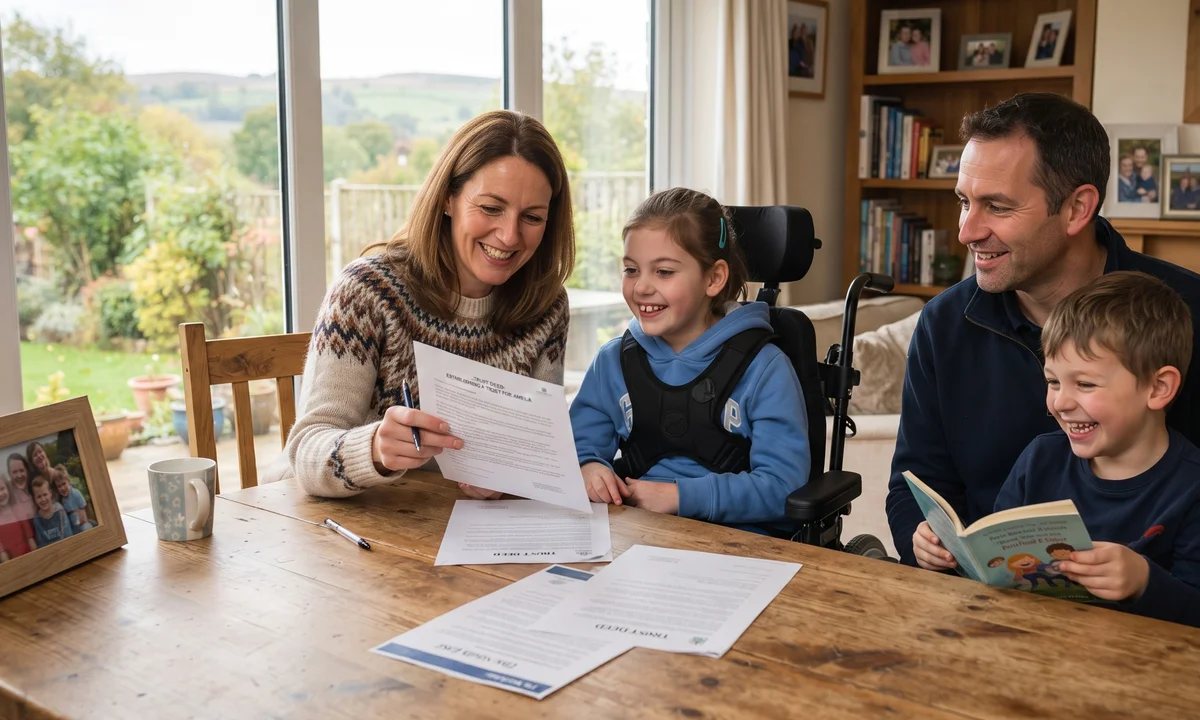
Home > Latest News > Setting Up a Trust for a Disabled Child in the North East
Setting Up a Trust for a Disabled Child in the North East
Date added: 20/09/26
What if the very inheritance you intend as a safety net actually puts your child’s essential support at risk?
It is a heavy question that many families in face when considering the long-term welfare of a child with additional needs.
You want to provide for them, yet the fear of mismanaged funds or the loss of Personal Independence Payment (PIP) often creates a state of paralysis.
We understand that you are looking for more than just legal documents; you are seeking the mental tranquillity that comes from knowing your child is protected by a knowledgeable protector.
Learning how to set up a trust for a disabled child is one of the most compassionate acts of preservation you can undertake.
This guide provides a professional step-by-step framework to help you navigate complex legal terminology and secure a future of professional oversight. We will explore how specific structures can safeguard assets whilst ensuring your child remains eligible for state benefits.
By working with an Estate planning consultant in collaboration with our group's legal specialists, you can move from a place of worry to a state of resolution, knowing your child's future is legally protected.
Key Takeaways
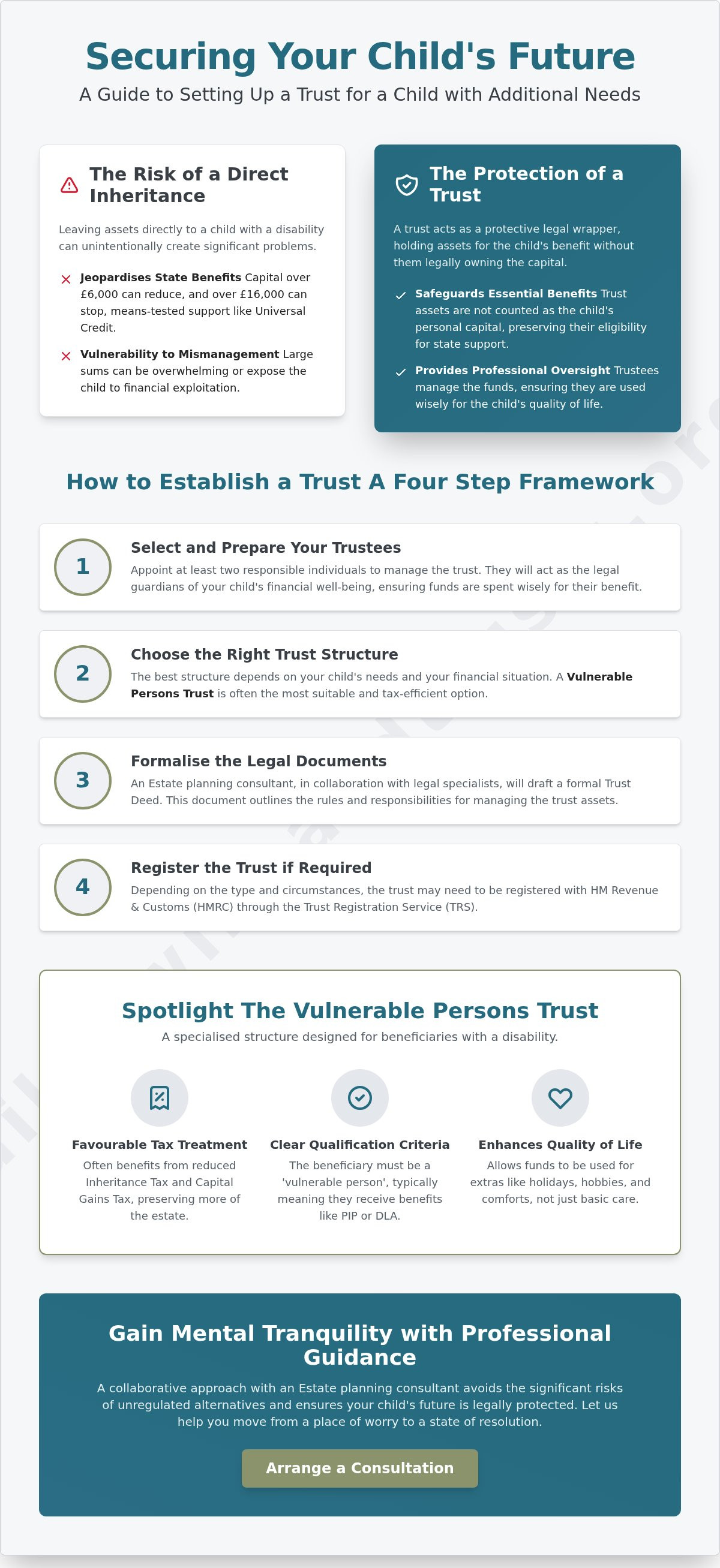
- Understand why a direct inheritance can unintentionally jeopardise essential benefits and how a trust acts as a protective shield for your child’s future.
- Learn how to set up a trust for a disabled child by selecting the specific legal structure that best matches your family’s unique financial circumstances.
- Discover why appointing at least two trustees is essential for providing long-term continuity and ensuring your child is never left financially vulnerable.
- Identify the formal registration steps needed to secure mental tranquillity whilst you are in a position to make clear and informed decisions.
- Explore the benefits of professional oversight and how a collaborative approach with an Estate planning consultant avoids the significant risks of unregulated DIY alternatives.
If you would like to discuss your family's specific circumstances with a professional, please feel free to get in touch with our team.
The vital role of trusts in protecting a disabled child's future
Parents naturally worry about what happens when they are no longer there to provide a protective shield for their children.
Leaving a direct inheritance might seem like the simplest solution, but for a child with a disability, it often creates more problems than it solves. Large sums of money can be overwhelming or easily mismanaged by those without the necessary financial experience.
More significantly, a direct windfall can trigger a reassessment of state support, potentially stripping away the very benefits your child relies on for their daily needs.
When you research how to set up a trust for a disabled child, you are looking for a way to create a protective wrapper around family assets.
Instead of the money belonging to the child legally, it is held by trustees for the child's benefit.
This distinction is vital. It provides the mental tranquillity that comes from knowing the funds are there to enhance their life without endangering their baseline security. It transforms an unpredictable inheritance into a stable, managed resource that lasts for the duration of the child's life.
Protecting means-tested benefits for your child
Most state support is means-tested. For benefits like Housing Benefit or Universal Credit, having capital over £16,000 usually stops payments entirely. Even sums over £6,000 can reduce the amount received.
By using a Vulnerable Persons Trust, the assets are not counted as the child's personal capital. This ensures that their eligibility for Personal Independence Payment (PIP) and other essential support remains intact.
It prevents a situation where an inheritance is simply used to fund basic care costs that the state should provide, allowing the family's hard-earned legacy to be used for things that truly improve the child's quality of life.
This structure is often referred to as a Special Needs Trust, and its primary goal is to ensure the beneficiary can enjoy a higher standard of living than state provision alone allows.
Ensuring long-term financial security and care
Financial security is about more than just numbers; it is about oversight. Many disabled children may lack the capacity to manage complex financial decisions or could be vulnerable to exploitation by third parties. A trust places responsible individuals in charge of the funds.
These trustees act as guardians of your child's financial well-being, ensuring money is spent wisely on extra comforts, hobbies, or specialised equipment.
This layer of professional oversight means your child is never left financially vulnerable, providing a steady presence in an unpredictable environment.
It ensures that the child's favourite activities and personal preferences are prioritised, maintaining their dignity and happiness for years to come.
To ensure you select the structure that best protects your child’s future, you can speak with one of our specialists today.
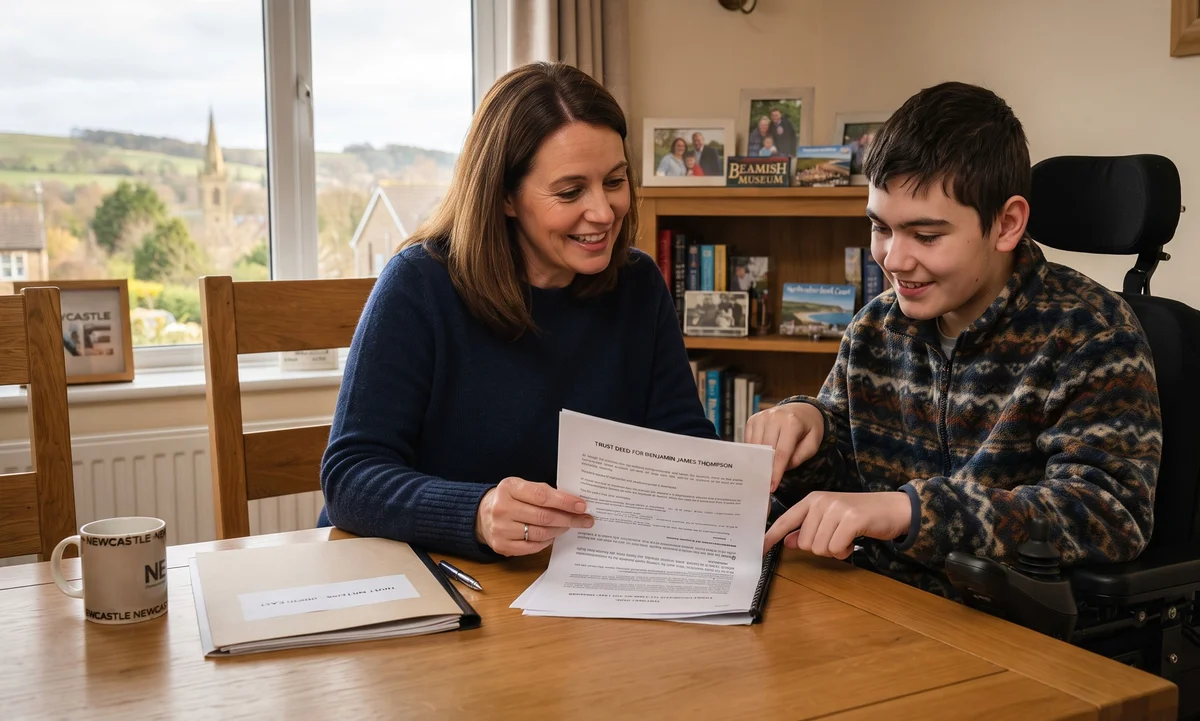
Choosing the right trust structure for your family needs
Every family in Wrexham has a different story. Some children might require high levels of support throughout their lives, whilst others may lead more independent existences with only occasional guidance.
Because of these variations, understanding how to set up a trust for a disabled child requires a bespoke approach.
There is no one-size-fits-all template. The right choice depends on the child's specific needs, the total value of your assets, and your long-term goals for the family estate.
When determining how to set up a trust for a disabled child, the choice of structure impacts more than just immediate access to funds.
It dictates the future tax position of your estate and the level of administrative work required by those you appoint to manage it.
The benefits of a Vulnerable Persons Trust
A Vulnerable Persons Trust is often the most tax-efficient route for families.
To qualify, the beneficiary must usually receive certain benefits like Disability Living Allowance (DLA) or Personal Independence Payment (PIP).
The tax advantages are significant. For the 2025-2026 tax year, the Capital Gains Tax (CGT) annual exempt amount for these trusts is £3,000, which is double the amount allowed for other trust types.
These trusts are also generally exempt from the 10-yearly Inheritance Tax charges that apply to standard discretionary structures. Official guidance on Trusts for vulnerable people confirms that trustees can elect for the trust's income to be taxed at the disabled person's personal marginal rates.
This often results in a lower overall tax burden, ensuring more of the money is preserved for the child's actual care.
When to consider a Discretionary Trust instead
Sometimes, a standard Discretionary Trust is a more appropriate tool. This is particularly true if you wish to provide for multiple children or grandchildren within a single structure. In this setup, the trustees have full discretion over how and when to distribute funds amongst a group of beneficiaries.
The tax rates are generally higher, with discretionary trusts often paying 45% on savings and rental income over £500.
However, the flexibility can be invaluable for complex family units. It allows trustees to respond to changing circumstances, such as a child’s health improving or another family member falling into financial hardship. The administrative requirements can be more intensive, so it is vital to weigh these against the potential benefits.
If you are unsure which path to take, an Estate planning consultant can help you evaluate the best fit for your family's unique situation.
If you would like help selecting the right people to protect your child's future, you can contact our specialist team for a private consultation.
How to select and prepare your chosen trustees
Selecting the right people is perhaps the most significant step in how to set up a trust for a disabled child.
Trustees are not merely names on a legal document. They become the guardians of your child’s financial security and quality of life once you are no longer able to oversee things yourself. It is a role that requires a unique blend of practical competence and deep personal commitment.
We recommend appointing at least two trustees. This ensures continuity and provides a system of checks and balances that protects the trust assets from being mismanaged by a single individual.
Having multiple perspectives also ensures that if one trustee is unable to act, the trust does not fall into a legal limbo.
Qualities to look for in a reliable trustee
A reliable trustee should possess a genuine understanding of your child’s unique challenges and preferences.
You want someone who will colour their decisions with empathy whilst maintaining the firm boundaries required for effective financial management. Organisational skills are equally vital. Managing a Vulnerable Persons Trust involves record-keeping, tax filings, and regular communication with beneficiaries.
Many families find that a mix of people works best. Combining the intimate knowledge of a family member with the objective expertise of an Estate planning consultant creates a robust support system.
This balance ensures the trust functions as a true Special Needs Trust, prioritising the child's well-being above all else.
The importance of professional trustees for complex estates
For larger estates or families with complex dynamics, professional oversight is often essential.
Appointing a professional service through our Professional Executor Service and Probate offering provides an extra layer of security.
It removes the heavy burden of legal liability from family members who may already be struggling with the emotional weight of a transition. Professional trustees ensure that the trust is managed according to strict legal standards for decades, providing a steady presence in an unpredictable environment.
They act as a neutral party, preventing potential conflicts amongst family members and ensuring your child’s interests remain the sole focus. This professional standing distinguishes the management of the trust from less formal or unregulated alternatives.
Once you have selected your team, you must prepare them for their responsibilities. Don't leave them to figure out their legal duties in a vacuum.
Discuss your long-term vision and provide them with a detailed letter of wishes. This proactive approach is a cornerstone of how to set up a trust for a disabled child effectively.
It ensures your intentions are carried out exactly as you planned, providing you with the mental tranquillity that your child's future is in safe, well-prepared hands.
If you are ready to take the first step toward securing your child's legacy, you can book a consultation with our dedicated team.
The formal steps to create and register the trust
Taking the time to understand how to set up a trust for a disabled child is a significant act of love and foresight. It is a process that is best started whilst you are in good health and have the clarity to make considered decisions.
When you act proactively, you ensure that the legal framework is robust enough to withstand future challenges. A professionally drafted trust deed is the foundation of this security.
This document must clearly outline the rules of the trust and the powers granted to your trustees. Because our organisation is part of a group that includes a law firm, we work in close collaboration with legal specialists to ensure your documents meet the highest professional standards.
Coordinating your trust with your existing Will and broader estate plan is essential for a seamless transition. All family assets, from the family home to savings and shares, must be properly identified and valued. This comprehensive approach ensures that every part of your legacy is working toward the same goal.
By aligning these different legal structures, you create a unified safety net that provides mental tranquillity for the entire family.
An Estate planning consultant will guide you through this coordination, making sure that no detail is overlooked and that your child’s future is never left to chance.
Drafting the trust deed and adding initial assets
The trust deed acts as the rulebook for your child's future care. It specifies exactly how the funds should be managed and what they can be used for.
A common practice is to activate the trust with a nominal sum, often just £10, to bring the legal entity into existence.
Once the structure is live, you can then identify which larger assets should be placed within it. This might include a portion of your property or specific investments.
Using a Vulnerable Persons Trust structure within the deed ensures that these assets are managed with the child’s specific needs in mind, providing the professional oversight necessary to maintain their quality of life.
Registering the trust with HMRC
Once the trust is created, it must be registered with the HMRC Trust Registration Service (TRS). This is a vital step in maintaining legal compliance and avoiding potential penalties. Regulations in this area are subject to change, with significant updates coming into force in mid-2026.
For instance, new exemptions now apply for low-value trusts with assets under £10,000 and an annual income under £5,000, provided they hold no UK land. However, most express trusts will still require formal registration.
Our team can guide you through the HMRC registration process to ensure you meet all deadlines and reporting requirements, keeping your child’s financial future secure and transparent.
To ensure your child’s financial future is managed with professional oversight and care, please reach out to our consultants for a private discussion.
Professional guidance for complex family requirements
Attempting to manage the complexities of trust law without professional oversight carries significant risks for vulnerable beneficiaries. DIY templates or informal arrangements often fail to account for the specific interaction between trust capital and means-tested benefits.
When you consider how to set up a trust for a disabled child, you are creating a structure that must remain robust for decades. A simple error in drafting could leave your child financially vulnerable or lead to the unintentional loss of their Personal Independence Payment (PIP).
We believe that securing your child's legacy is a lifelong commitment rather than a one-off transaction.
Our approach at Aiker Wills and Trusts is built on a collaborative relationship with our group’s own law firm, providing families in the North East with a steady presence in an unpredictable environment.
How an Estate planning consultant simplifies the process
An Estate planning consultant acts as your dedicated guide, translating technical legal jargon into a clear and supportive plan.
They manage the heavy administrative burden of identifying assets and coordinating with legal specialists, which allows you to focus your energy on your child's daily care.
These sensitive discussions take place in a reassuring and professional environment where your family's history and future goals are treated with the respect they deserve.
By choosing this professional route, you avoid the pitfalls of unregulated alternatives and ensure your protective structures are built on a foundation of legal authority.
Ongoing reviews and lifelong advisory support
Life is not static. Laws change, and your child’s needs will evolve as they grow older. Regular reviews are essential to ensure the trust remains fit for purpose throughout the child's life.
For instance, the updates to the Trust Registration Service expected in mid-2026 demonstrate why professional oversight is so important for ongoing compliance. By maintaining a lifelong advisory relationship, you ensure that your protective structures are updated in line with new regulations and shifting family circumstances.
This proactive diligence provides the mental tranquillity that comes from knowing your child will always be provided for, regardless of how the external landscape shifts.
Our commitment is to act as a knowledgeable protector of your child's interests, ensuring the continuity of your intentions for generations to come.
To ensure your child's future is protected by a professional structure, contact our Estate planning consultants for a reassuring and expert consultation.
Securing your child's financial future with confidence
Securing a safe and stable future for a disabled child is a journey that requires both heart and technical precision.
By choosing a structured approach, you ensure that your legacy provides for your child’s quality of life without jeopardising their essential state support. We have explored the vital role of specific structures like the Vulnerable Persons Trust and the importance of selecting trustees who offer a blend of empathy and financial competence.
Understanding how to set up a trust for a disabled child is the first step toward achieving the mental tranquillity you deserve.
Aiker Wills and Trusts is a trading style of Elsworth Associates Ltd, established in 2003. We work in a collaborative partnership with Aiker Legal Ltd for regulated legal services, ensuring that the welfare of families is protected by specialist expertise. We are dedicated to acting as a steady presence for your family, providing professional oversight that lasts for decades.
Taking these steps today means your child will always have a knowledgeable protector by their side, allowing you to move forward with peace of mind.
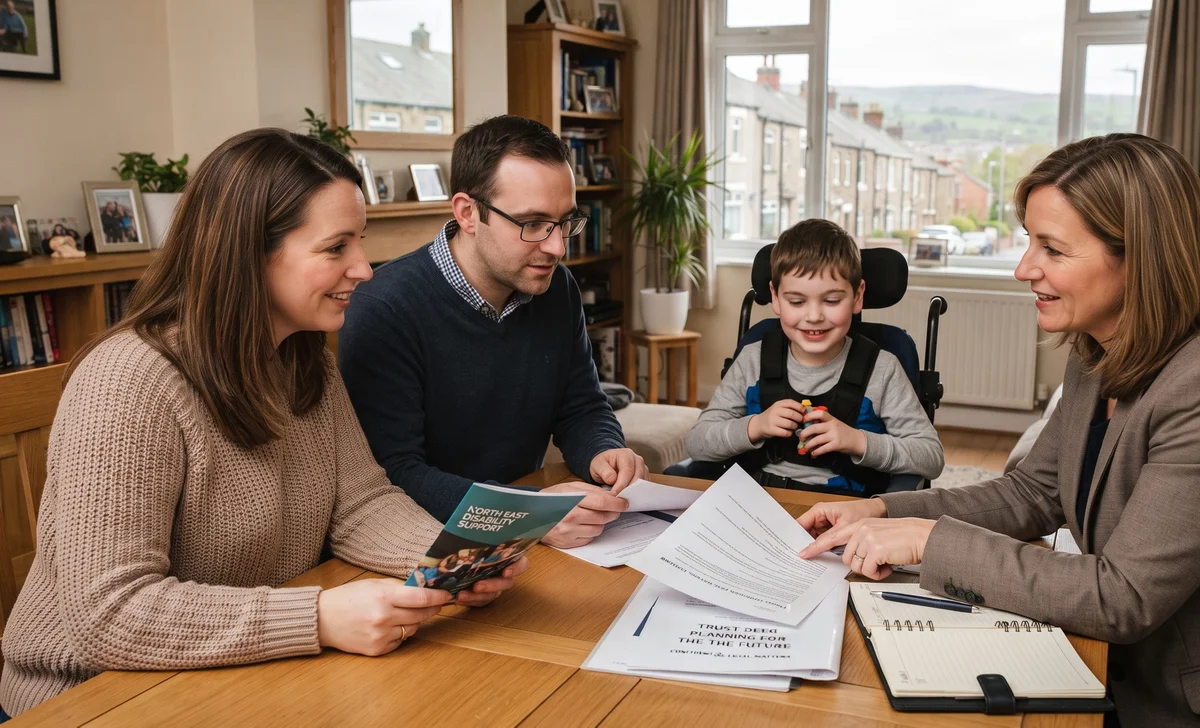
Frequently Asked Questions
What is a Vulnerable Persons Trust and how does it help?
A Vulnerable Persons Trust is a specific legal structure designed to protect the assets of someone who meets the UK definition of a vulnerable person.
It helps by ensuring that the capital held within the trust is not counted toward the beneficiary's personal assets, which preserves their eligibility for state support.
This structure also qualifies for special tax treatments, such as lower Income Tax and Capital Gains Tax rates compared to standard discretionary trusts.
Can my child still receive PIP if they have a trust fund?
Yes, your child can continue to receive Personal Independence Payment (PIP) because it is not a means-tested benefit.
However, many other forms of support, such as Universal Credit or Housing Benefit, are strictly means-tested.
By understanding how to set up a trust for a disabled child, you ensure that any inheritance or gift is held by trustees rather than the child directly, which keeps their total personal capital below the relevant limits for these other essential benefits.
Who should I choose as a trustee for my disabled child?
You should choose individuals who are financially responsible and deeply committed to your child's long-term welfare.
It is often best to appoint a mix of family members who understand your child's daily needs and professional trustees who provide objective oversight and legal expertise.
This combination ensures that the trust is managed with both empathy and professional standards, reducing the emotional and administrative burden on your loved ones during difficult transitions.
How much money can I put into a trust for a disabled person?
There is no legal upper limit on the amount of money you can place into a trust for a disabled person.
However, large transfers may have Inheritance Tax implications that you should consider carefully.
Transfers into a Disabled Person's Trust are typically treated as Potentially Exempt Transfers (PETs), meaning no immediate Inheritance Tax is due if the person making the gift survives for seven years.
An Estate planning consultant can help you determine the most tax-efficient funding strategy.
What happens to the money in the trust if my child passes away?
The trust deed will specify exactly what happens to any remaining funds if the primary beneficiary passes away.
You can name other family members or charities as remaindermen to receive the residual assets. This ensures that your family's hard-earned legacy continues to support the causes or people you care about, rather than being subject to the standard rules of intestacy.
It provides a sense of permanence and purpose for your family assets.
Do I need a solicitor to set up a trust for my child?
Whilst it is possible to find templates online, you should always use professional services to ensure the trust deed is legally robust and fit for purpose.
Learning how to set up a trust for a disabled child through an expert ensures your child's specific legal and financial interests are protected.
Our organisation is part of a group that owns a law firm, allowing our Estate planning consultants to work in close collaboration with legal specialists for your peace of mind.
How is a trust for a disabled person taxed in the UK?
Trusts for vulnerable persons enjoy a special tax status that allows them to be taxed as if the income and gains belonged to the disabled person. This is often much more favourable than the 45% tax rate applied to standard discretionary trusts for income over £500.
For the 2025-2026 tax year, these trusts also benefit from a higher Capital Gains Tax annual exempt amount of £3,000, providing significant savings that stay within the trust for your child's benefit.
Can I put my family home into a trust for my child?
Yes, you can place your family home into a trust to ensure your child has a secure place to live for the rest of their life.
This is a common strategy in the North East to prevent the home from being sold to pay for care costs or being lost to third-party claims.
By including the property in a trust, you provide your child with permanence and stability, knowing their home is legally protected by professional trustees.
Disclaimer
Please note that the information provided is for general guidance only and should not be taken as professional financial advice tailored to your specific circumstances.
Free Estate Planning Guide
Download from our website or have it emailed to you to read later.
Request nowLooking for advice?
Arrange a no obligation scheduled call with a Wills and Trusts expert.
Request a callRecent Posts

A Comprehensive Guide to the Family Asset Protection Trust in the UK
You spend a lifetime paying off your mortgage and maintaining your home, only to realise that a single change in your health could see that property...

How Much Does a Mirror Will Cost in the UK for 2026
The most affordable way to protect your partner today could actually become the most expensive mistake your family ever faces. When you're looking to...
Setting Up a Trust for a Disabled Child in the North East
What if the very inheritance you intend as a safety net actually puts your child’s essential support at risk?It is a heavy question that many families...
Updating your will after divorce in 2026
Did you know that reaching the final legal end of your marriage doesn't actually cancel your existing wishes?Many people understandably believe that...

Mirror Wills, Protecting Your Partner in North Wales
What if the legacy you've spent a lifetime building for your spouse and children ends up in the hands of a complete stranger?It's a heavy thought,...

How to Register a Lasting Power of Attorney for Your Future Security?
Did you know that 15% of all applications to register a lasting power of attorney contain errors that lead to significant delays and potential rejection...