





Home > Latest News > Providing Security through a Vulnerable Persons Trust and Professional Estate Planning
Providing Security through a Vulnerable Persons Trust and Professional Estate Planning
Date added: 22/06/26
Imagine the profound relief of knowing your child will always be supported, even when you are no longer there to manage their affairs.
For many families, the desire to provide a secure future through a vulnerable person's trust is often tempered by a persistent worry that a sudden inheritance might do more harm than good.
You likely fear that a well-intentioned gift could inadvertently cancel their means-tested benefits or leave them vulnerable to financial mismanagement. It's a heavy burden to carry, but you don't have to face these complexities alone.
This specialised legal structure offers a robust solution that balances compassionate care with rigorous financial strategy.
By reading this guide, you'll discover how to safeguard your loved one's eligibility for state support whilst significantly reducing the tax burden on their inheritance.
We'll explain the essential HMRC rules for 2026, the role of an Estate planning consultant in managing these structures, and the practical steps you can take today to ensure your family's legacy remains a source of lifelong tranquillity.
Key Takeaways
- Understand how a vulnerable person's trust acts as a protective shield for disabled individuals or bereaved minors who cannot manage their own financial affairs.
- Learn about the specific tax advantages and exemptions provided by HMRC that help preserve more of your family's wealth for the beneficiary's care.
- Discover the legal mechanisms used to ensure that a significant inheritance does not jeopardise essential means-tested state benefits.
- Explore the differences between specialised vulnerable-person structures and standard discretionary trusts to find the right balance between control and security.
- See how working with an Estate planning consultant provides the professional oversight needed to navigate complex regulations and ensure long-term peace of mind.
Table of Contents
- What is a Vulnerable Persons Trust, and Who Does it Protect
- The Specific Tax Benefits and Eligibility Criteria for Vulnerable Beneficiaries
- Balancing Control and Security through Different Trust Structures
- Protecting Means-Tested Benefits whilst Providing for the Future
- How an Estate Planning Consultant Can Secure Your Family Legacy
If you would like to discuss how to protect your family's future, please contact our team today for professional guidance.
What is a Vulnerable Persons Trust, and Who Does it Protect
Life’s complexities often require us to look far into the horizon, especially when we care for those who cannot easily navigate the world on their own.
A vulnerable person's trust serves as a vital safeguard, providing a structured way to manage assets for individuals who are unable to oversee their own financial affairs. It's a protective legal framework that ensures a loved one's future is defined by security rather than uncertainty.
This type of arrangement is known worldwide as a Special Needs Trust and serves as a steadfast guardian for those facing significant life challenges. Professional oversight is key.
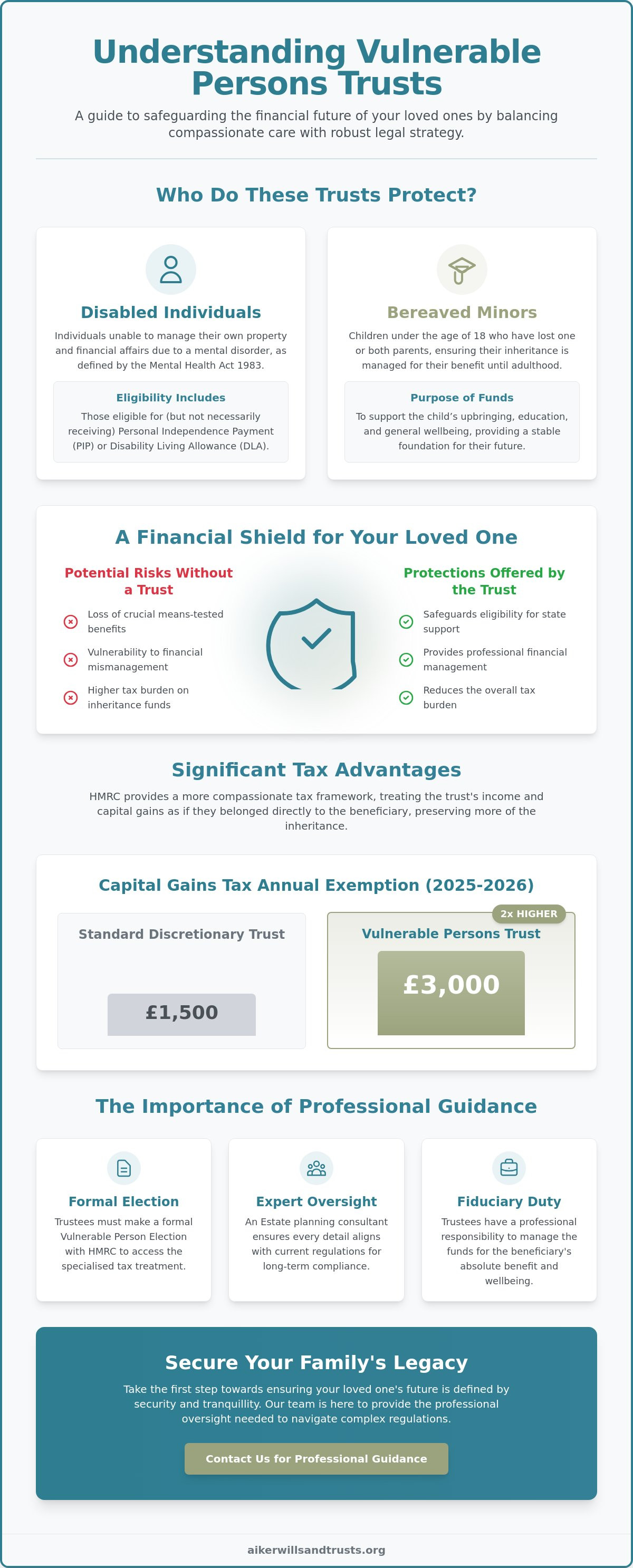
Within this framework, two specific groups receive protection, namely disabled individuals and bereaved minors.
The legal definition is precise to ensure that help reaches those who truly need it. Under the Mental Health Act 1983, a vulnerable person is someone who is unable to manage and administer their property and affairs because of a mental disorder.
By establishing this trust, the settlor creates a legacy of care, while the trustees take on the professional responsibility of managing the funds for the beneficiary's absolute benefit.
Qualifying Conditions for Disabled Beneficiaries
Eligibility for this specialised tax treatment often hinges on the beneficiary's health status. Most commonly, this includes individuals who receive Personal Independence Payment (PIP) or Disability Living Allowance (DLA).
It is a common misconception that the person must already be receiving these payments. In reality, they only need to be eligible for them to qualify for the trust's protections.
This also extends to anyone who, due to a mental disorder, lacks the capacity to handle their own financial matters. Our team works closely with an Estate planning consultant to ensure every detail aligns with current HMRC standards.
The Role of Bereaved Minors in Protective Trusts
For parents, the thought of leaving a child behind is difficult, but proactive planning offers immense peace of mind. These trusts are specifically designed to protect children under the age of 18 who have lost a parent.
The assets held in the trust are used to support the child’s upbringing, education, and general well-being until the child reaches adulthood. This process often begins with the careful drafting of Wills, which serve as the initial blueprint for your family's long-term security.
Once the minor reaches the age of 18, the assets are typically transferred to them, providing a stable foundation for their independent life.
If you have questions about protecting your loved one's inheritance, please talk to us today for expert advice.

The Specific Tax Benefits and Eligibility Criteria for Vulnerable Beneficiaries
HMRC provides a more compassionate tax framework for families supporting those with additional needs. The core reason for this special treatment is to ensure that funds intended for care and wellbeing aren't disproportionately reduced by standard trust tax rates.
By establishing a vulnerable person's trust, you can access a regime that treats the trust's income and gains as if they belonged directly to the beneficiary. This often results in significant savings, as it allows the trust to utilise the individual's personal tax allowances rather than the much lower thresholds typically applied to legal structures.
To access these benefits, trustees must make a formal Vulnerable Person Election. This isn't a one-time administrative task but a commitment to an annual process that requires precision.
For the 2025-2026 tax year, the Capital Gains Tax advantages are particularly notable. While a standard trust is limited to an annual exempt amount of £1,500, a trust for a vulnerable person enjoys a higher allowance of £3,000.
This doubled threshold provides greater flexibility when managing assets or properties held within the trust for the beneficiary's long-term security.
Inheritance Tax Advantages and Exemptions
One of the most reassuring aspects of this structure is how it interacts with Inheritance Tax. Unlike standard discretionary trusts, which often face charges every ten years, these protective arrangements are generally exempt from such periodic taxes.
The assets are typically treated as being part of the beneficiary's estate for tax purposes. This simplifies the long-term management of the fund.
Additionally, the rules allow for up to £3,000 per year, or 3% of the assets, to be used for someone other than the disabled person without losing the trust's special status. This provides a small but helpful degree of flexibility for wider family needs.
Making the Vulnerable Person Election
Securing these advantages requires following a strict administrative path using the VPE1 form. Trustees must submit this election no later than 12 months after the 31 January following the end of the tax year in which they want the relief to begin.
If this deadline is missed, the trust may be taxed at much higher rates for that period. Professional oversight ensures no tax relief is missed and that all documentation meets the specific requirements of Trusts for vulnerable people.
Working alongside an Estate planning consultant helps you navigate these deadlines with confidence. You can reach out to us to learn more about how to start this process correctly.
If you're ready to explore the best structure for your family's needs, please talk to us today for a personalised consultation.
Balancing Control and Security through Different Trust Structures
Choosing the right legal vehicle for a loved one's future requires a delicate balance between tax efficiency and long-term flexibility.
A vulnerable person's trust is often the preferred choice because of its unique tax status, yet it's helpful to compare it against a standard discretionary trust. While a vulnerable person's trust is strictly focused on the needs of one primary individual to satisfy HMRC, a discretionary trust, such as our Standard Asset Trust, allows for a broader group of beneficiaries. This distinction is vital if you wish to support other family members alongside a vulnerable relative.
Flexibility is the cornerstone of effective estate planning. Beneficiaries often have fluctuating needs, and their circumstances can change over many decades.
Trustees must have the authority to adjust distributions based on current needs, whether that's funding a specific medical treatment or addressing a sudden change in living arrangements.
This level of control ensures that the money is used responsibly and only when it's truly needed. It's about creating a steady, protective presence that adapts as life evolves.
Choosing the Right Trustees for Your Loved One
The individuals you appoint to manage the trust are the guardians of your intentions. Many families initially look to relatives because they understand the beneficiary's favourite activities and personal preferences.
However, the role carries a heavy weight of responsibility. Lay trustees must handle complex annual tax returns and ensure the trust remains compliant with evolving regulations.
Appointing professional trustees, who work in close collaboration with our associated law firm, can relieve this burden from the family. For those seeking broader community support, Mencap's Wills and Trusts service provides excellent resources for navigating these personal choices whilst ensuring the beneficiary's voice is heard.
Protective Will Property Trusts and Vulnerable Beneficiaries
Securing the family home is frequently a top priority for parents. By incorporating a Protective Will Property Trust into your estate plan, you can grant a vulnerable person a legal right to reside in the property for their lifetime.
This arrangement protects the underlying capital for future generations whilst ensuring the individual has a safe and permanent place to live. It's a proactive strategy that prevents the home from being considered as part of a beneficiary's personal capital, which is essential for maintaining their long-term security.
An Estate planning consultant can help you integrate this structure seamlessly into your wider plans to provide a truly comprehensive safety net.
To ensure your loved one's benefits are fully protected, please talk to us today for expert guidance.
Protecting Means-Tested Benefits whilst Providing for the Future
One of the most persistent anxieties for families is the fear that a generous inheritance might inadvertently cause a vulnerable relative to lose their essential state support. This concern is well-founded because many benefits, such as Universal Credit and Housing Benefit, are subject to a strict capital limit of £16,000.
If an individual's personal savings exceed this threshold, their entitlement to means-tested support usually ceases. However, by utilising a vulnerable person's trust, assets are held legally by trustees rather than the beneficiary, which changes how they're viewed by state agencies.
This distinction is vital for residents in areas like Wrexham and across the country. Local authorities generally disregard capital held within these protective structures when assessing a person’s financial position for care or support services.
It's a strategic way to ensure that your hard-earned assets serve as a supplementary fund to provide comfort and security.
A well-structured trust preserves both the inheritance and the continued receipt of state benefits, ensuring the capital remains a blessing rather than a burden.
Managing Payments for Daily Needs and Quality of Life
Trustees have the power to fund items and experiences that significantly improve a beneficiary's quality of life without breaching benefit rules.
This might include paying for specialist therapy, adapted equipment, or even a favourite annual holiday.
The key to maintaining benefit eligibility is that trustees should pay third-party providers directly. By avoiding direct cash transfers to the beneficiary, the money remains outside their personal capital assessment.
We recommend that trustees organise regular reviews of the beneficiary's circumstances to ensure the trust continues to meet their evolving needs whilst remaining compliant with current regulations.
Avoiding the Pitfalls of Direct Inheritance
Leaving money directly to someone who is vulnerable carries substantial risks, including the potential for financial exploitation or abuse. It also leaves the individual responsible for complex financial decisions that they may not be equipped to handle.
A DIY Will is particularly dangerous in these complex situations because even a small drafting error can cause the trust to be disregarded by HMRC or local authorities.
By working with a professional Estate planning consultant, you can mitigate these risks and ensure the legal structure is robust and enduring. If you would like to discuss creating a secure future for your family, contact our team to begin your journey toward lasting peace of mind.
If you would like to secure your family's future with professional guidance, please contact our team today to arrange a consultation.
How an Estate Planning Consultant Can Secure Your Family Legacy
Planning for a loved one's future is a deeply personal journey that requires more than just standard legal documents.
It's about building a protective shield around your family's history and ensuring your intentions are carried out with dignity. When you work with an Estate planning consultant, you benefit from a collaborative approach that brings together our expertise and the specialised skills of our associated law firm.
This partnership ensures that every vulnerable person's trust we create is legally robust and perfectly aligned with your family's unique circumstances. We don't believe in one-size-fits-all solutions because your family's needs are as unique as the individuals within it.
Our commitment to you doesn't end once the documents are signed. We pride ourselves on a lifelong advisory relationship, staying by your side as regulations change and your family's situation evolves.
For many families in Wrexham and the surrounding areas, the peace of mind our professional executor and probate services provide is invaluable.
It means that when the time comes, the complex administrative burden won't fall on your grieving relatives. Instead, professional hands will handle the details, ensuring the trust continues to provide the security you intended.
Integrating Lasting Power of Attorney into Your Plan
A trust is a powerful tool for the future, but it's often essential to have protections in place for the present day.
An LPA acts as a vital companion to a trust structure. It allows you to appoint trusted individuals to manage a vulnerable person's affairs whilst you are still alive, but perhaps unable to do so yourself.
There is a critical difference between decisions regarding property and financial affairs and those concerning health and welfare. By addressing both, you ensure that every aspect of your loved one's life is managed by people who truly care about their well-being.
Taking the First Step towards Peace of Mind
The process begins with a sensitive and professional consultation designed to assess your family's specific requirements. We take the time to listen to your concerns and to understand the beneficiary's daily life.
This allows us to help you select the most appropriate structure, whether that is a vulnerable persons trust or a combination of protective measures. Our goal is to move you from worry to absolute resolution.
By taking this first step, you're not just signing a document; you're protecting your history and securing your family's future for generations to come.
Securing a Brighter Future for Your Family
Establishing a vulnerable person's trust is about more than just legal paperwork; it's a profound act of care that ensures your loved one's wellbeing remains the priority.
We've explored how these structures protect essential means-tested benefits whilst allowing for significant tax savings through specialised HMRC elections. By choosing a bespoke approach over a standard document, you can ensure that your family home and capital are managed with the precision they deserve.
Our team operates as part of a wider group that owns a regulated law firm, providing you with the security of a collaborative and professional legal partnership. We specialise in protective trust structures and offer professional executor and probate services to handle the administrative weight for you.
This lifelong advisory relationship is designed to bring you mental tranquillity in an unpredictable world.

Frequently Asked Questions
Who is considered a vulnerable beneficiary for tax purposes?
A vulnerable beneficiary is typically defined as either a disabled person or a bereaved minor under the age of 18 who has lost a parent.
To qualify as disabled, the individual must usually receive or be eligible for specific benefits such as Personal Independence Payment or Disability Living Allowance.
This also includes individuals who are unable to manage their own affairs due to a mental disorder as defined by the Mental Health Act 1983.
Can a vulnerable person be a trustee of their own trust?
Whilst it is legally possible for a beneficiary to act as a trustee, it is rarely advisable in these specific circumstances.
The primary purpose of a vulnerable person's trust is to provide professional management and protection for someone who may struggle to handle financial complexities.
Appointing independent trustees ensures that the assets are managed responsibly and that the beneficiary's long-term interests are always prioritised over immediate pressures.
Will setting up a trust stop my child from receiving PIP or DLA?
No, setting up a trust will not affect a child's entitlement to Personal Independence Payment or Disability Living Allowance.
These specific benefits are not means-tested, meaning they are awarded based on the individual's needs rather than their financial capital. The trust is actually designed to protect other means-tested benefits, such as Universal Credit, which would be at risk if the child inherited a large sum of money directly.
What happens to the trust if the vulnerable person recovers or passes away?
The outcome depends entirely on how your Estate planning consultant originally drafted the trust deed.
Typically, if the beneficiary passes away, the trust assets are distributed to other family members or charities according to your wishes. If the individual recovers and no longer meets the vulnerability criteria, the trust may continue as a standard discretionary trust, although the specific tax advantages provided by HMRC would likely cease to apply.
Do I need a solicitor to set up a Vulnerable Persons Trust?
Whilst you are not legally required to use a solicitor, the complexity of HMRC rules makes professional guidance essential.
Our firm works in close collaboration with an associated law firm to ensure that every trust is drafted with the necessary legal precision.
This combined expertise ensures that your trust is compliant with current regulations and provides the robust protection your family needs during sensitive life transitions.
Can a Vulnerable Persons Trust hold a family home or property?
Yes, a vulnerable person's trust can hold various assets, including the family home or other residential properties. This is a common strategy to ensure a loved one has a permanent place to live whilst protecting the property's underlying value from being treated as personal capital.
By placing the home in trust, you provide the beneficiary with the right to reside in it for their lifetime, thereby securing their accommodation and your family's legacy.
How much does it cost to manage a trust for a disabled person annually?
The annual costs of managing a trust vary depending on the complexity of the assets held and the level of professional oversight required. Expenses typically include preparing annual tax returns for HMRC and any fees associated with professional trustees.
Whilst we cannot provide specific figures here, we always recommend a detailed consultation to understand the ongoing requirements of your specific structure. This ensures that the trust remains a cost-effective solution for your family.
What is the difference between a Vulnerable Persons Trust and a Discretionary Trust?
The primary difference lies in how HMRC treats the trust for tax purposes. A vulnerable person's trust receives special tax treatment that allows it to use the beneficiary's personal tax allowances, which is often much more efficient.
In contrast, a standard discretionary trust is taxed at the highest rates and may be subject to periodic Inheritance Tax charges every ten years.
Both offer protection, but the vulnerable persons structure is specifically optimised for long-term care.

Article by
Jon Ainge
Jon has over 15 years’ experience in financial services and has helped raise over £50 million for charity. As a director and co-founder of Aiker Wills & Trusts, a trading style of FCA-regulated Elsworth Associates, John aims to help clients protect their legacy through specialist estate planning.
Disclaimer
Please note that the information provided is for general guidance only and should not be taken as professional financial advice tailored to your specific circumstances.
Talk to your Aiker Legacy Adviser
Arrange a home visit now to discuss your current situation, and which options might suit you best, and how regular reviews can help you be sure your legacy isn’t at risk. The whole process is easy, and starts by simply giving us your details.
Recent Posts

Blended Family Estate Planning in 2026 and How to Protect Your Loved Ones
Did you know that over 40% of adults now have at least one step-relationship within their family circle? While modern families come in many beautiful...

How to Protect Your Home From Care Fees in 2026?
What if the home you have spent decades paying for was no longer yours to pass on? For many, the reality of the 2026 care fee thresholds means that...

A Comprehensive Guide to the Family Asset Protection Trust in the UK
You spend a lifetime paying off your mortgage and maintaining your home, only to realise that a single change in your health could see that property...

Business LPAs, How to Protect Your Company Today
If you were suddenly unable to attend your office in tomorrow, would your company be able to pay its staff or settle its invoices by the end of the...

How Much Does a Mirror Will Cost in the UK for 2026
The most affordable way to protect your partner today could actually become the most expensive mistake your family ever faces. When you're looking to...

Home Visit Will Writing Service in the North Wales
Did you know that, despite our shared desire to protect those we love, only 37% of UK adults currently have a valid will?It is a startling figure that...