




Home > Latest News > Choosing Between a Professional Executor and a Family Member for Your Estate
Choosing Between a Professional Executor and a Family Member for Your Estate
Date added: 30/10/26
Imagine a grieving son or daughter sitting at a kitchen table, surrounded by complex inheritance tax forms and legal notices, whilst trying to navigate the emotional weight of a recent loss.
It is a heavy burden to place on a loved one, yet many people assume that appointing a family member is the only way to ensure their wishes are handled with care.
The choice between a professional executor and a family member is rarely about a lack of trust; it is about deciding who is best equipped to protect your hard-earned assets during a period of intense grief.
You likely want to make things as easy as possible for those you leave behind, ensuring that your Will is followed exactly without causing friction amongst siblings or heirs. In this guide, you will learn the key differences between professional and family executors so you can choose the option that offers complete peace of mind.
We will explore how to balance legal expertise with emotional support, helping you minimise stress for your family and protect your estate from costly administrative errors.
Key Takeaways
- Understand the significant administrative and legal responsibilities involved in estate management to ensure your wishes are carried out accurately.
- Evaluate the benefits of a professional executor vs a family member by balancing the need for technical expertise with the value of personal family history.
- Discover how impartial professional oversight can prevent family arguments and protect your assets from complex tax or legal errors.
- Learn why factors like geographic location and financial complexity should influence who manages your final affairs.
- Explore how working with an Estate planning consultant can simplify the probate process and give your family much-needed peace of mind.
Table of Contents
- Understanding the Role and Weight of Executor Duties
- The Reality of Appointing Family Members as Executors
- Why Appointing a Professional Executor Provides Essential Safeguards
- Finding the Right Balance for Your Specific Circumstances
- Professional Probate and Executor Services from Aiker Wills and Trusts
If you would like to discuss your estate with our team, please get in touch with us here.
Understanding the Role and Weight of Executor Duties
Losing a relative is a time for profound reflection, but it also marks the start of an intricate legal process. An executor is the person you choose to take full legal responsibility for your estate and ensure your final intentions are respected.
This position carries immense trust and a heavy workload, often requiring a level of precision that can feel overwhelming during a time of deep mourning.
When weighing a professional executor vs a family member, it's essential to understand the Role and Weight of Executor Duties before committing to a decision.
Legal Responsibilities and Timeframes
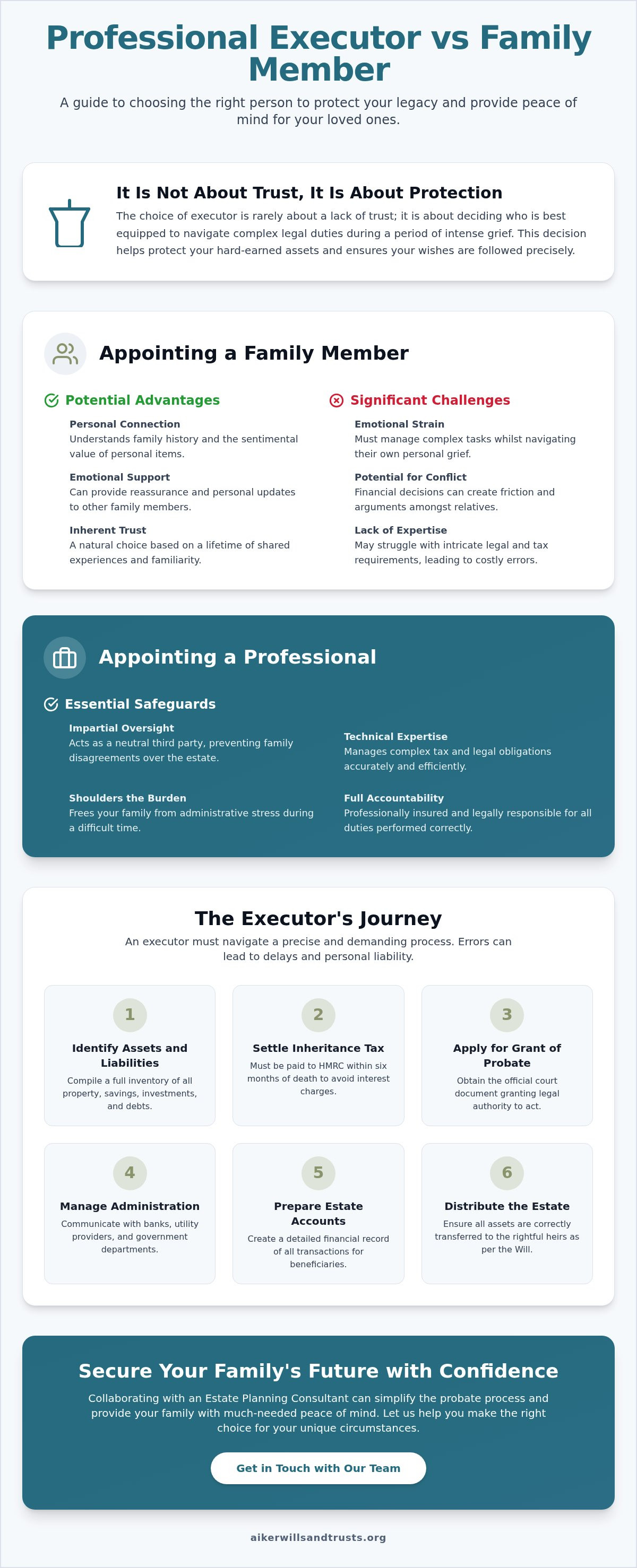
The journey begins with identifying every asset and liability in your estate. This includes property, savings, and personal items, as well as any outstanding debts or tax obligations.
Accuracy isn't just preferred; it is a legal requirement. In the UK, you must settle any Inheritance Tax due within six months of the end of the month of death. If you miss this timeframe, HMRC can charge interest, which reduces the total value left for your loved ones. Once these financial matters are organised, the executor must apply for a Grant of Probate through the court system.
This document grants legal authority to manage your affairs, but the application requires careful attention to complex forms.
The Administrative Burden of Probate
Beyond the courtroom, the administrative burden is often what surprises people most. An executor must spend hours communicating with banks, utility providers, and government departments, whilst also managing insurance policies and property maintenance.
For each beneficiary, executors must prepare detailed estate accounts showing how assets were valued and debts were paid.
This process is rarely swift. Even a simple estate can take many months to resolve, and more complex situations involving trusts or multiple properties can easily last for years. If the correct procedures aren't followed, it can lead to significant delays and potential personal liability for the person in charge.
Speaking with an Estate planning consultant can clarify how to manage these pressures effectively.
If you would like to discuss how to best support your family through your Will, reach out to our advisors for a conversation.
The Reality of Appointing Family Members as Executors
Selecting a loved one to manage your estate is often seen as a gesture of deep trust. It's natural to want someone who knows your story to close the final chapter of your life's work.
However, the debate surrounding a professional executor vs a family member often hinges on the distinction between emotional closeness and administrative capacity. Whilst many relatives feel honoured to be named in a Will, they may not fully grasp the hundreds of hours of work that often follow a death.
This role requires diligence that can be hard to maintain while someone is also processing their own grief.
Personal Connection and Knowledge of Wishes
Family executors bring a unique empathy to the process that a distant entity cannot replicate. They understand which items hold sentimental value beyond their monetary worth, ensuring that a favourite watch or a collection of old letters reaches the right person with the care it deserves.
Because they know the beneficiaries personally, they can often provide informal updates and reassurance to the rest of the family during what is a very difficult time. This personal touch can make the transition feel less like a legal transaction and more like a family coming together to honour a legacy.
An executor who understands the nuances of your family history can be a real comfort.
The Emotional Strain and Potential for Conflict
Grief does not always bring out the best in people. The reality is that probate stress can create friction even among the closest siblings or relatives. When a family member must make objective financial decisions while mourning a loss, the pressure can be immense.
An executor may be blamed for delays or perceived unfairness, even if they are doing their absolute best. By choosing between a professional executor and a family member, you can decide whether you want your loved ones to spend their time on legal paperwork or supporting one another.
If you're concerned about maintaining family harmony, it may help to speak with an Estate planning consultant about your options.
Relatives often choose to act as executors to save on upfront professional fees, but this can be a false economy if they make mistakes.
For instance, if a family member miscalculates asset values or misses a tax deadline, the resulting complications can cost far more than professional help. A family member is also often personally liable for any mistakes they make during the administration.
This adds a layer of anxiety that can be avoided by involving experts who work collaboratively with legal professionals to protect your family's future security.
If you would like to explore how professional oversight can secure your family's future, please speak with our team for expert guidance.

Why Appointing a Professional Executor Provides Essential Safeguards
Choosing between a professional executor and a family member often depends on the complexity of your legacy. Whilst a family member brings personal devotion, a professional brings a protective layer of impartiality.
This neutrality is a vital safeguard when family dynamics are complicated or when significant assets are involved. It ensures your Will's instructions are carried out exactly as written, without the influence of personal bias or family friction.
Professionals provide a steady hand, ensuring every beneficiary is treated fairly and in accordance with the law.
Expertise in Complex Financial Matters
Professional executors are trained to spot tax-saving opportunities an untrained eye might miss.
This includes the correct application of transferable nil-rate bands and the residence nil-rate band, which can significantly reduce the amount of Inheritance Tax paid to HMRC. For estates involving various trusts, the technical requirements for filing accounts and tax returns are incredibly stringent.
Professionals can also handle complex assets such as business interests, agricultural land, or foreign property. They ensure that all potential debts are advertised correctly in the Gazette.
This step is essential because it protects the estate from future claims that could arise long after the assets have been distributed.
Protection Against Personal Liability
A critical detail often missed in estate planning is that executors can be personally liable for administrative errors. If a family member accidentally underpays tax or distributes funds to the wrong person, they are legally responsible for making up the shortfall from their own pocket.
This is a heavy prospect for someone who is already struggling with a bereavement. By appointing a professional, you remove this legal risk from your loved ones. Professional firms are regulated and carry professional indemnity insurance. This means the estate is financially protected against errors, providing a level of security that no individual family member can offer.
It turns a potential legal minefield into a managed professional service.
Working with an Estate planning consultant allows you to explore these safeguards in detail. It's about creating peace of mind for your family during an unpredictable time. By choosing a regulated professional, you ensure that your assets are managed with the highest standards of oversight and technical accuracy.
Working with legal experts ensures your hard-earned achievements are preserved for the next generation without placing an unfair burden on those you love most.
To find the best balance for your family, get in touch with our team for a consultation.
Disclaimer
Please note that the information provided is for general guidance only and should not be taken as professional financial advice tailored to your specific circumstances.
Free Estate Planning Guide
Download from our website or have it emailed to you to read later.
Request nowLooking for advice?
Arrange a no obligation scheduled call with a Wills and Trusts expert.
Request a callRecent Posts

What is an LPA? Why UK Families Need Protection
Imagine a sudden crisis where you are unable to speak for yourself, and your closest family members are told they have no legal right to manage your...

Understanding the Rules for Dying Without a Will in the UK
Did you know that approximately 60% of UK adults haven't yet formalised their final wishes?It's a startling figure, especially when you consider how the...

Business LPAs, How to Protect Your Company Today
If you were suddenly unable to attend your office in tomorrow, would your company be able to pay its staff or settle its invoices by the end of the...

How to Register a Lasting Power of Attorney for Your Future Security?
Did you know that 15% of all applications to register a lasting power of attorney contain errors that lead to significant delays and potential rejection...

Duties of an Executor, A Step-by-Step UK Checklist
Being named as an executor is a profound final act of service, but it is also a significant legal responsibility that can feel like a heavy burden...

Estate Planning for Unmarried Couples and Why it is Essential in 2026
Did you know that nearly half of the British public still believes in the myth of "common law marriage," despite the fact that it offers no legal protection...