



Home > Latest News > Estate Planning for Unmarried Couples and Why it is Essential in 2026
Estate Planning for Unmarried Couples and Why it is Essential in 2026
Date added: 02/09/26
Did you know that nearly half of the British public still believes in the myth of "common law marriage," despite the fact that it offers no legal protection whatsoever?
In 2026, the reality for cohabiting partners remains stark, as the laws of intestacy continue to overlook those who haven't entered a marriage or civil partnership.
You've likely spent years building a shared life and a home together, and it's only natural to feel that your commitment should be recognised by the state.
However, without proactive estate planning for unmarried couples, a surviving partner could face the devastating prospect of being forced out of the family home or losing out on vital assets.
We understand that discussing these topics can feel uncomfortable, but true mental tranquillity comes from knowing your loved ones are secure.
This article will help you navigate the complexities of property ownership and the upcoming changes to probate fees, ensuring your partner is fully provided for.
You'll discover how an Estate planning consultant can help you achieve legal certainty, protect your children from previous relationships, and minimise the stress of probate during an already difficult time.
By taking these steps now, you're acting as a guardian for your family's future and ensuring your shared achievements are preserved for the person who matters most.
Key Takeaways
- Understand why the concept of a common law spouse has no legal standing and how intestacy rules could inadvertently exclude your partner from inheriting.
- Learn how professional estate planning for unmarried couples provides the legal certainty needed to protect your shared home and financial future.
- Discover the vital difference between joint tenancy and being tenants in common, including why a severance of tenancy might be required to safeguard your intentions.
- Identify the specific Inheritance Tax challenges facing cohabiting partners and the strategic steps available to help manage these liabilities.
- Recognise the importance of working with an Estate planning consultant to ensure your documents are robust and prepared in collaboration with regulated solicitors.
To ensure your partner is protected and your future is secure, please get in touch with our team today for a professional consultation.
The Legal Reality for Unmarried Partners in the UK
Living together as a couple is a significant milestone, yet many people in England and Wales are unaware of the fragile legal ground they stand on.
In 2026, as property values in areas like Wrexham continue to climb, the stakes for cohabiting couples have never been higher.
The law doesn't automatically recognise your commitment in the same way it does for married couples.
This lack of recognition can lead to a devastating emotional and financial toll if one partner passes away unexpectedly.
Without a structured plan, your shared history and the home you have built together could be at risk of passing to unintended beneficiaries.
It's not just about the money; it's about the security of the person you love most.
Debunking the Myth of Common Law Marriage
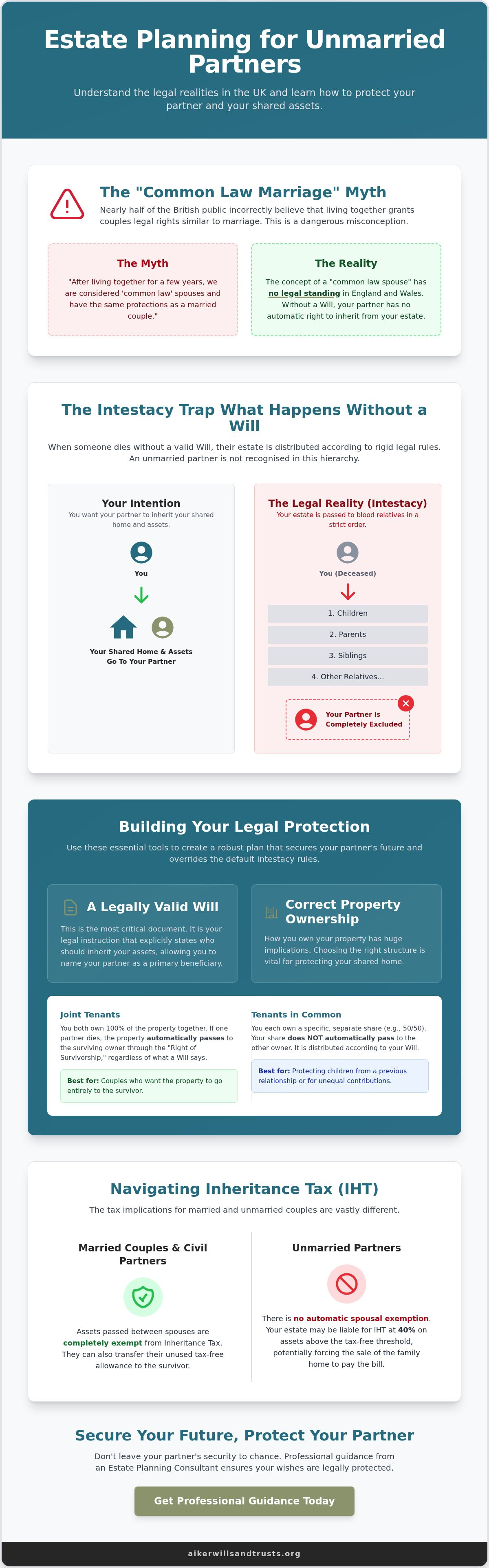
It's a common misconception that living together for a certain number of years grants you the status of a "common law spouse." In reality, this term has no legal standing.
So, whether you have lived together for two years or twenty, the law treats you as two separate individuals unless you have taken formal steps.
Even if you have children together, the surviving partner doesn't inherit anything by right.
This is why estate planning for unmarried couples is so essential; it bridges the gap between your personal reality and the cold letter of the law.
You shouldn't have to rely on luck or the goodwill of distant relatives to maintain your lifestyle or stay in your own home.
What Happens Under the Rules of Intestacy
When someone dies without a valid will, their estate is distributed according to the rules of intestacy.
This rigid hierarchy prioritises blood relatives, starting with children, then moving to parents and siblings.
Your partner is entirely absent from this list. If you own your home in your sole name or as tenants in common, your partner could be forced to move out to allow the legal heirs to claim their inheritance.
Whilst the Inheritance (Provision for Family and Dependants) Act 1975 allows some partners to claim for financial provision, this is a complex, expensive, and stressful process that can be avoided entirely with professional guidance.
Using a professional will writing service ensures you override these default rules, providing the security your partner deserves.
An Estate planning consultant can help you navigate these complexities, ensuring your intentions are clearly documented and legally robust.
By acting now, you're preventing a future of legal uncertainty and potential conflict for those you leave behind, allowing you to focus on the life you're building together today.
To secure your partner’s future and gain legal certainty, reach out to us for a private consultation with an expert advisor.
Essential Documents to Protect Your Partner and Assets
Securing your partner’s future shouldn’t be left to chance. Whilst marriage provides an automatic legal framework for inheritance, cohabiting couples must build their own safety net through deliberate action.
Effective estate planning for unmarried couples is about more than just money; it is about ensuring the person you love has the authority and resources they need when life takes an unexpected turn.
By putting the right documents in place, you move from a state of vulnerability to one of mental tranquillity.
This process begins with a clear understanding of the tools available to you and how they work together to form a comprehensive shield around your shared achievements.
The Role of Wills for Cohabiting Couples
A Single Will is the bedrock of any robust estate plan. It allows you to name your partner as a beneficiary, ensuring they receive the assets you intended for them.
Without this document, the rules of intestacy will dictate who receives your estate, often leaving a long-term partner with nothing.
For couples with shared goals and identical wishes, Mirror Wills offer a coordinated approach that ensures both partners are protected regardless of who passes away first.
You can also use these documents to name your partner as an executor or to leave specific sentimental items that hold deep personal value.
Residents in North Wales can benefit from Professional Single-Person Will Services tailored to their specific needs.
Lasting Power of Attorney for Total Peace of Mind
Many couples mistakenly believe they can automatically manage each other's affairs if one of them loses mental capacity.
This is a dangerous assumption. Without a Lasting Power of Attorney (LPA), your partner may have to apply to the Court of Protection to make even basic decisions, a process that is often slow and expensive.
There are two distinct types of LPA you should consider. A Property and Financial Affairs LPA allows your partner to manage bank accounts and bills, whilst a Health and Welfare LPA gives them a voice in your medical care and daily routine.
Appointing your partner formally ensures that the person who knows you best is the one making the most sensitive decisions on your behalf.
To ensure these documents stand up to scrutiny, they must be drafted with professional oversight. An Estate planning consultant can provide the expertise needed to navigate complex family structures, often working in collaboration with regulated solicitors to provide a seamless service.
If you haven't yet reviewed your current arrangements, now is the time to discuss your options with a professional who understands your unique circumstances.
To ensure your partner is protected and your future is secure, please get in touch with our team today for a professional consultation.
Securing Your Shared Home through Property Protection
The home is often the most significant asset a couple will ever own, representing both financial security and a lifetime of shared memories.
For those who aren't married, the legal structure of property ownership determines whether a surviving partner can remain in their home or if they face a legal challenge from distant relatives.
As we have explored, the rules of intestacy in England and Wales offer no automatic provision for cohabiting partners.
This makes the technical details of how you hold your property a cornerstone of effective estate planning for unmarried couples.
Tenants in Common vs Joint Tenants
When you purchase a property together, you usually choose between two distinct forms of legal ownership.
Understanding these differences is vital for your long-term peace of mind. The two main types are as follows.
- Joint Tenants Both partners own the property as a whole. If one partner passes away, the property passes automatically to the survivor through the right of survivorship, regardless of what a will might say.
- Tenants in Common Each partner owns a specific, defined share of the property. This share does not pass automatically to the survivor but is instead distributed according to the owner's will.
For unmarried couples, especially those who have contributed different amounts toward the deposit or have children from previous relationships, being tenants in common is often the preferred choice.
It allows you to protect your individual contribution whilst ensuring you can choose exactly who inherits your share.
If you currently own your home as joint tenants, a Severance of Tenancy can be used to change this structure, giving you the flexibility needed to protect your partner’s right to live there.
Using Trusts to Protect the Family Home
Once your property is held as tenants in common, you can utilise a Protective Will Property Trust.
This is a vital part of estate planning for unmarried couples who want to balance a partner's needs with those of their children. This trust grants your partner a "right to occupy" the home for their lifetime, ensuring they have a secure place to live.
Crucially, the capital value of your share is preserved for your chosen beneficiaries, such as your children, preventing it from being lost if the survivor later enters a new relationship.
This strategy also offers a layer of protection against the rising costs of care. Because the share is held in trust rather than owned outright by the surviving partner, it may be protected from a full assessment for local authority care home fees.
For couples in Wrexham who want to ensure their hard-earned legacy is preserved, a Standard Asset Trust can provide further professional oversight for managing shared property interests.
This proactive approach ensures that your home remains a sanctuary for your partner whilst preserving your long-term achievements for the next generation.
To ensure your partner is protected and your future is secure, please get in touch with our team today for a professional consultation.
Navigating Inheritance Tax and Financial Security
Whilst the emotional bond between cohabiting partners is no different from that of a married couple, the taxman views the situation through a very different lens. Inheritance Tax is a levy on the estate of someone who has passed away.
For married couples, the "spousal exemption" allows assets to pass between them entirely tax-free. Unmarried couples don't enjoy this privilege.
This means that if you leave your estate to your partner, any value exceeding the current Nil Rate Band of £325,000 could be subject to a 40% tax bill.
Without careful estate planning for unmarried couples, your partner might find themselves facing a significant financial burden at the very time they are most vulnerable.
By taking proactive steps, you can help shield your shared wealth and ensure your partner is left with the financial security you intended.
The lack of a transferable Nil Rate Band for unmarried partners further complicates matters. Married individuals can pass their unused tax-free allowance to their spouse, potentially doubling the surviving partner's threshold.
Cohabiting couples must rely solely on their individual allowances. This disparity makes the use of a Family Asset Protection Trust particularly valuable.
Such structures can help manage how assets are held and distributed, providing a layer of protection that the law does not automatically grant to your relationship.
It’s about creating a bespoke financial fortress that respects your commitment and preserves your long-term achievements.
Managing the Inheritance Tax Burden
Transfers between unmarried partners are potentially chargeable to tax, which can lead to the unintended loss of family wealth.
A professional Estate planning consultant can help you structure your assets to be more tax efficient, ensuring that more of your estate reaches your partner rather than the tax office.
For specific tax planning needs, an Immediate Post-Death Interest Will Trust can be a powerful tool. This allows you to provide for your partner whilst maintaining a level of control over the ultimate destination of your assets, balancing immediate support with long-term legacy goals.
Protecting Vulnerable Beneficiaries
For families with children who have additional needs, the stakes are even higher. A Vulnerable Persons Trust ensures that an inheritance does not interfere with means-tested benefits, providing essential support without jeopardising state assistance.
At Aiker Wills and Trusts, we take a compassionate approach to these sensitive family matters, recognising that every situation is unique.
We work to ensure that your most vulnerable loved ones are cared for with the dignity and security they deserve.
If you are concerned about how your estate might impact your family’s financial stability, you can book a professional review of your circumstances to explore the best protective measures for your needs.
To ensure your partner is protected and your future is secure, please get in touch with our team today for a professional consultation.
Professional Guidance for Unmarried Couples in Wrexham
Planning for the future is a deeply personal task that requires a steady hand and a compassionate ear.
In Wrexham, families are increasingly choosing varied paths to build their lives together, and the legal system is often slow to keep pace with these modern structures.
This is why estate planning for unmarried couples requires a bespoke approach that respects your unique history whilst providing the ironclad security of a formal legal framework.
Our Estate planning consultant serves as a dedicated guardian of your interests, ensuring that your intentions are not only understood but also legally enforceable. We believe that every couple deserves the mental tranquillity that comes from knowing their partner is safe from the unpredictability of life.
Our firm operates as part of a group that owns a law firm, which allows us to offer a uniquely collaborative service.
We don't view the legal profession as a distant entity; instead, we work alongside regulated solicitors to ensure every document we produce meets the highest professional standards.
This relationship ensures that the advice you receive is both human-centric and technically precise.
By bridging the gap between sensitive life planning and rigorous legal oversight, we provide a level of protection that generic alternatives simply cannot match.
You aren't just another case file to us; you are a local neighbour whose family welfare is our primary focus.
Why Professional Estate Planning Matters
The temptation to use a DIY will kit can be strong, yet the risks often far outweigh the initial savings.
A single error in wording or a failure to follow strict witnessing rules can render a document invalid or easily contested in court. A professional review by an Estate planning consultant ensures that every potential loophole is closed.
For those who want to ensure their wishes are carried out with the utmost care, our Professional Executor Service and Probate offers comprehensive support.
This removes the administrative burden from your grieving partner, providing a professional hand to guide them through the complexities of the probate process.
Starting Your Journey in Wrexham
Beginning the process of protecting your partner is simpler than you might imagine. It starts with a conversation where we listen to your concerns and help you identify the specific tools needed to secure your home and assets.
Our team is known for being empathetic and supportive, acknowledging that these discussions can sometimes be uncomfortable. To help you understand your options, you might find our Mirror Wills vs Single Wills comparison a helpful starting point.
We are here to act as your long-term collaborators, providing regular reviews to ensure your plan evolves as your life does.
When you are ready to take that first step toward lasting security, we invite you to speak with one of our local advisors for a private and respectful consultation.
If you are ready to begin protecting your partner and securing your shared home, please get in touch with our specialist team for professional support.
Securing Your Shared Future Today
Life's journey is often unpredictable, but your partner's security shouldn't be left to chance.
We have explored how the lack of automatic inheritance rights and the complexities of property ownership can leave cohabiting couples vulnerable.
By embracing professional estate planning for unmarried couples, you are choosing to replace uncertainty with a documented legacy that protects your home and your shared wealth.
It is about ensuring that the person who has walked beside you for years is never left without a voice or a roof over their head.
As a proud member of the Elsworth Associates Ltd group, established in 2003, we bring over two decades of dedicated experience to local families.
Our specialised expertise in Property Protection Trusts and asset security is delivered through a collaborative partnership with Aiker Legal Ltd for all regulated services.
This ensures you receive the highest professional standards whilst maintaining the personal, empathetic touch you deserve.
If you wish to discuss your specific circumstances with a professional, please contact our team for a consultation. Taking this step today ensures your commitment is recognised and your achievements are preserved for the person who matters most.

Frequently Asked Questions
Is there such a thing as a common law spouse in the UK?
No, the concept of a common law spouse has no legal standing in England and Wales. Regardless of how many years you have lived together or whether you have children, the law does not grant cohabiting partners the same automatic inheritance rights as married couples.
Without a valid will, the survivor may be left with no legal right to any part of their partner's estate.
Does my partner automatically inherit our house if we are not married?
Your partner will only inherit the house automatically if you own the property as joint tenants. Under this ownership structure, the right of survivorship ensures the property passes directly to the surviving owner.
If the house is held in a sole name or as tenants in common, your partner has no automatic right to the property unless you have specifically named them in your will.
Can I leave everything to my partner in my will if I have children from a previous marriage?
Yes, you have the legal right to leave your estate to whomever you choose, including your partner.
However, it is often wise to use a trust to balance your partner's needs with your children's interests. This allows your partner to benefit from your assets during their lifetime whilst ensuring the capital is eventually preserved for your children from a previous relationship.
What happens if my partner loses mental capacity and we do not have an LPA?
If your partner loses mental capacity without a Lasting Power of Attorney, you do not have an automatic legal right to manage their finances or make decisions about their medical care.
You would instead be forced to apply to the Court of Protection for a deputyship order. This is a significantly more expensive and lengthy process than setting up an LPA whilst your partner still has capacity.
Do unmarried couples have to pay Inheritance Tax on assets left to each other?
Yes, unmarried couples are subject to Inheritance Tax on any assets left to each other that exceed the individual Nil Rate Band, which is currently £325,000.
Unlike married couples, cohabiting partners do not benefit from the spousal exemption or the ability to transfer unused tax-free allowances.
Professional estate planning for unmarried couples is vital for managing potential tax burdens and protecting your shared wealth.
How can a trust help an unmarried couple protect their assets?
A trust can provide a surviving partner with the right to live in the family home for life whilst ensuring the underlying value is protected for other beneficiaries, such as children.
It also helps to ring-fence assets from being fully assessed for local authority care home fees.
This structure provides a secure future for your partner whilst maintaining the integrity of your long-term family legacy.
Is it possible to change a joint tenancy to tenants in common without a solicitor?
It is possible to sever a joint tenancy by serving a formal notice and updating HM Land Registry, but professional guidance is highly recommended to ensure the process is handled correctly.
An Estate planning consultant can manage this transition as part of a wider protective strategy. This ensures the severance is legally robust and works in harmony with the rest of your estate plan.
Why should I use an Estate planning consultant instead of a DIY will kit?
DIY will kits often lack the technical depth required to handle complex cohabitation issues and can be found invalid if the strict rules of witnessing are not followed.
An Estate planning consultant provides personalised, expert advice and works in collaboration with regulated solicitors to ensure your documents are legally sound.
This professional oversight provides the peace of mind that your estate planning for unmarried couples will stand up to scrutiny.
Disclaimer
Please note that the information provided is for general guidance only and should not be taken as professional financial advice tailored to your specific circumstances.
Free Estate Planning Guide
Download from our website or have it emailed to you to read later.
Request nowLooking for advice?
Arrange a no obligation scheduled call with a Wills and Trusts expert.
Request a callRecent Posts
Lasting Power of Attorney, Essential Care Planning
Did you know that whilst one in three people will lose mental capacity at some point in their lives, research from 2025 suggests that only around...

What is an LPA? Why UK Families Need Protection
Imagine a sudden crisis where you are unable to speak for yourself, and your closest family members are told they have no legal right to manage your...
A Comprehensive Guide to the Family Asset Protection Trust in the UK
You spend a lifetime paying off your mortgage and maintaining your home, only to realise that a single change in your health could see that property...
Supporting those who serve. Through the Armed Forces Covenant
At Aiker Wills & Trusts, we are proud to be a Bronze Award Holder for the Armed Forces Covenant.The Armed Forces Covenant is unique. It’s not a charity...
Setting Up a Trust for a Disabled Child in the North East
What if the very inheritance you intend as a safety net actually puts your child’s essential support at risk?It is a heavy question that many families...

Understanding the Rules for Dying Without a Will in the UK
Did you know that approximately 60% of UK adults haven't yet formalised their final wishes?It's a startling figure, especially when you consider how the...